Botanical Name: Panax quinquefolius
The scientific name of American ginseng, Panax quinquefolius means “universal medicine with five blades,” which refers to the plant’s considerable reputation as a medicinal plant.
The Native Americans have a long historical tradition using the herb both as herbal medicine and in spiritual and ceremonial practices.
There are at least ten species of the genus Panax, native to North America and eastern and southwestern parts of Asia.
The best known and most used is Chinese or Asian ginseng (Panax ginseng) which is closely related to American ginseng.
N.B Eleuthero (Eleutherococcus senticosus), also known as Siberian ginseng, is not a member of the genus Panax. It is often sold as “true ginseng” but even if it shares some of the same medicinal effects, it contains different active ingredients.
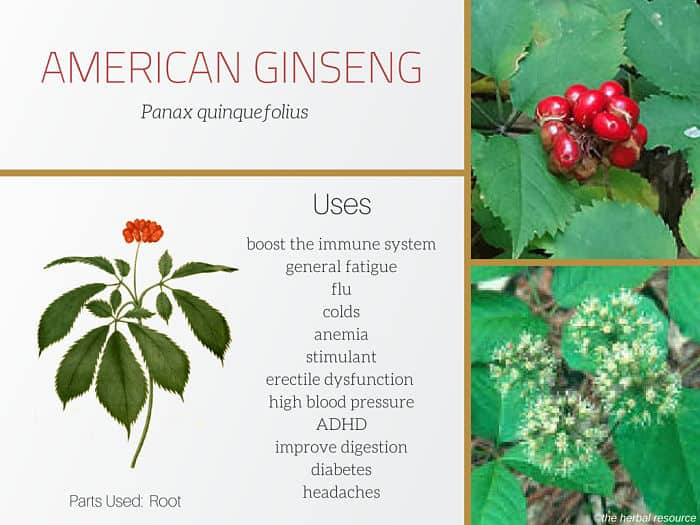
What is American Ginseng Used For?
American ginseng has been used as an herbal remedy for a variety of ailments but mainly for stress and mental, emotional and physical enhancement.
People have used American ginseng, e.g., for the following conditions:
- boost the immune system
- general fatigue
- improving performance (physically and mentally)
- poor appetite
- indigestion
- constipation
- erectile dysfunction (ED)
- high blood pressure
- ADHD
- improve digestion
- flu
- colds
- anemia
- diabetes
- headaches
American Ginseng Uses to Boost the Immune System
American ginseng is often used to boost a weakened immune system and lessen the symptoms of colds and flu.
Studies have shown that it enhances the immune system by boosting the performance of cells that play a role in immunity. 1
May Fight Fatigue, Reduce Stress and Increase Energy Levels
Modern research indicates that the American ginseng can help adrenal fatigue and as a regulator of the endocrine system. The herb is considered an adaptogen and can be useful for mild to moderate impairments in the adrenal glands. 2
It is used as a treatment for insomnia associated with chronic fatigue syndrome, and to alleviate many of the symptoms of jet lag.
Some think the herb can boost endurance and enhance the physical performance of athletes by increasing the amount of available oxygen in the muscles and some studies indicate that American ginseng might improve concentration. 3
When American ginseng is taken over a period of one to three months, it is thought to regulate the production of stress hormones favorably by reducing the stress response. 4
Although the exact mechanism responsible for the herb stress-reducing effect is not known, it is likely that the herb protects an area of the brain called the hippocampus against stress hormones. This mechanism may also explain why it may be useful to prevent memory loss and loss of cognitive abilities in people who suffer from bipolar disorder, depression and a disorder of the adrenal glands known as Cushing’s disease. 5
May be Beneficial for People with Diabetes
American ginseng may effectively protect against spikes in blood glucose levels after ingestion of carbohydrate-rich meals in both healthy subjects and patients with type 2 diabetes (non-insulin-dependent diabetes) when the herb is taken with or immediately after meals. 6
Scientists, therefore, believe it might be useful as an alternative to conventional treatment of type 2 diabetes.
They think the herb could have some potential in controlling or preventing diabetes. Both men and women with type 2 diabetes might benefit from American ginseng in relatively high doses.
Can be Useful for ADHD
American ginseng, in conjunction with Ginkgo biloba, might be useful in improving some of the symptoms of attention deficit hyperactivity disorder (ADHD) in children and teenagers
A Canadian study showed that children with ADHD who were administered both American ginseng and Ginkgo biloba twice a day for a month showed improvements in social problems, anxiety, hyperactivity, and impulsivity. 7
The study was small but indicative. Bigger and more thorough studies are needed to confirm the herb’s effectiveness for ADHD symptoms fully.
Can be Useful for Heart Health and High Blood Pressure
American ginseng may be beneficial for heart health, high blood pressure and protect against heart failure. 8
Still, the evidence of the effectiveness of the root as a treatment for high blood pressure has been inconsistent.
One study showed that when 1500 mg American ginseng was administered twice a day for twelve weeks, it did not have an antihypertensive effect.
In another study, where test subjects suffering from diabetes and high blood pressure took 1000 mg three times daily for 12 weeks, showed that it did have a hypertensive effect. 9
These inconsistent results might be because different products were used, the quality of the root and the amount of ginsenosides, the actives substances in the root.
American Ginseng May Enhance Fertility and Sexual Performance
Traditionally, this medicinal plant is used to restore sexual desire in men.
Although scientific studies involving human test subjects in this context can be challenging to implement, experiments with laboratory animals indicated that it increases interest in sex by influencing the action of the neurotransmitter dopamine in the brain. 10
Different tribes of Native Americans have used American ginseng to treat infertility in women although no clinical studies have confirmed the herb has any value for this purpose.
However, it is known that American ginseng has some active ingredients, just like Asian ginseng, that stimulate the pituitary gland, which, in turn, stimulates the lining of the uterus.
Other Medicinal Uses
The herb has been used to treat allergies and allergic asthma
American ginseng may be of particular value as a treatment for some symptoms associated with menopause such as hot flashes and for women with breast cancer by increasing the effect of medication used in chemotherapy. 11
Some in vitro experiments have shown that this herb can inhibit the growth of cancer (colorectal cancer). 12
Active Substances and Constituents
American ginseng contains about 25 ginsenosides belonging to a group of chemical substances called triterpene saponins. The ginsenosides are divided into three categories, panaxadiol, panaxatriol and oleanolic acid derivatives.
The root also contains various acids, beta-sitosterol, tannins, magnesium, vanadium, zinc and trace amounts of germanium, which may be partially responsible for the herb’s health benefits.
The rootstocks also contain some essential oil.
Plant Parts Used
The root and sometimes the leaves.
The roots are not ready to be harvested for medicinal purposes until the plant is at least five years old.
After harvesting the roots are washed, dried and cut into slices for later use as powder, decoctions, and extracts.
Dosage and Administration
Short-term use of American ginseng is thought to have little effect, and it is usually recommended to use the herb for an extended period.
The herb can be taken as an infusion (tea), a decoction, in dried powdered form or as a tincture.
Herbalists sometimes recommend the following doses:
As a tea: Pour 3 cups of boiling water over 1 to 2 g dried root and allow it simmer for 20 minutes before the root is strained from the tea. This dose may be taken three times daily.
As a decoction: A decoction is made of 3 to 6 g of the dried root and then simmered in half a liter of water for half an hour. This decoction can be divided into three portions consumed throughout the day.
As a tincture: Use 3-5 mL (60-100 drops) of the tincture (1:5 in 30 percent alcohol), three times daily.
A low dose of 200 mg, which can be increased gradually up to 600 mg daily, is often recommended when commercial capsules of American ginseng are used. Still, the manufacturer’s instructions should always be followed.
It is essential to choose a good commercial supplement as the quality of products containing the herb’s root can vary greatly.
The great popularity and value of American ginseng have resulted in the plant´s extinction in much of its native habitat.
If the plant is found in the wild, allow it to grow in peace, and do not buy roots that are labeled “wild American ginseng.”
Possible Side Effects and Interactions of American Ginseng
American ginseng is considered a very safe herb to use even over an extended period. Some sources indicate the herb is safe to use during pregnancy, while others believe pregnant or lactating women should avoid it.
People with diabetes may need to keep an extra eye on their insulin levels if using American ginseng since the herb has a glucose lowering effect.
Human studies have demonstrated that high doses of American ginseng can have disruptive effects on blood thinning agents like warfarin in otherwise healthy patients. Therefore, avoid consuming large amounts of this herb when using such medications. 13
Some people can experience sleeplessness when they take American ginseng, especially if used with food or beverages containing caffeine. This side effect will reduce by cutting down on caffeine intake and refraining from taking American ginseng in the evening.
Other Common Names
- Canadian ginseng
- Western ginseng
- Tartar root
- Five-fingers
- Red berry
- Occidental ginseng
- Amerikanischer Ginseng (German)
- Ginseng d’Amérique (French)
- Ginseng americano (Spanish)
Habitat
American ginseng is found wild in the eastern part of the United States, including Alabama and in Canada. Due to the plant’s overexploitation in the wild, it is, unfortunately, becoming an endangered species.
In 1947 the cultivation of the herb began in China, but large-scale farming did not start until around 1980. The plant requires a fertile soil with high humus content and full shade.
Plant Description
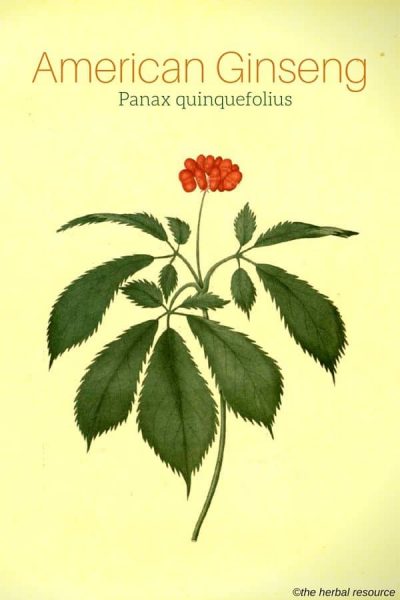
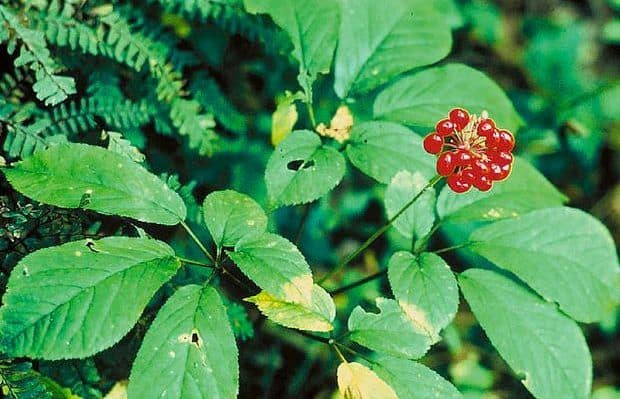
American ginseng is a perennial plant that can grow up to 75 cm in height. The aromatic root is fleshy with stringy shoots. The plant usually has three large compound leaves in a wreath around the stem.
It blooms in June or July, and the flowers are small, green and white and slightly fragrant. The fruits, which develop in late summer, are kidney-shaped berries with two seeds. The roots are not ready to be used as a medicinal herb until the plant is at least five years old.
Supporting References
Yarnell, Eric, Kathy Abascal & Robert Rountree: Clinical Botanical Medicine. 3md Ed, Revised and Expanded. New Rochelle, New York. Mary Ann Liebert, Inc. 2009.
Balch, Phyllis A.: Prescription for Herbal Healing. New York, Avery 2002.
Winston, David and Steven Maimes: Adaptogens. Herbs for Strength, Stamina, and Stress Relief. Rochester, Vermont. Healing Arts Press 2007.
Blumenthal, Mark (senior editor): The ABC Clinical Guide to Herbs. Austin, Texas. American Botanical Council 2003.
Tilgner, Sharol: Herbal Medicine. From the Heart of the Earth. Cresswell, Oregon. Wise Acres Press 1999.
Tierra, Lesley: Healing with the Herbs of Life. Berkeley, California. Crossing Press 2003.
Qi L-W, Wang C-Z, Yuan C-S. Ginsenosides from American ginseng: Chemical and pharmacological diversity. Phytochemistry. 2011;72(8):689-699. doi:10.1016/j.phytochem.2011.02.012.
Skenderi, Gazmend: Herbal Vade Mecum. 800 Herbs, Spices, Essential Oils, Lipids Etc. Constituents, Properties, Uses, and Caution. Rutherford, New Jersey. Herbacy Press 2003.
Foster, Steven & Yue Chongxi: Herbal Emissaries. Bringing Chinese Herbs to the West. Rochester, Vermont. Healing Arts Press 1992.
Foster, Steven: Herbs for Your Health. A Handy Guide for Knowing and Using 50 Common Herbs. Loveland, Colorado. Interweave Press 1996.
Ody, Penelope: The Complete Medicinal Herbal. London. Key Porter Books 1993.


Thordur Sturluson
Latest posts by Thordur Sturluson (see all)
- What is the Difference Between Hemp and Marijuana? - June 3, 2019

Leave a Reply