Botanical Name: Astragalus membranaceus, A. propinquus, A. mongholicus.
Although more than 2,000 species belong to the genus Astragalus, there are only two related species A. membranaceus and A. mongholicus that are primarily used for health purposes.
Astragalus has been used in China since ancient times. The Chinese name for the plant “huang qi” means “yellow leader” and it is one of the most important medicinal herb in traditional Chinese medicine (TCM)
In Asia, astragalus root has for centuries been regarded as a herb that increases vital energy, boosts immunity and protects the body from illnesses in the same manner as ginseng (Panax ginseng).
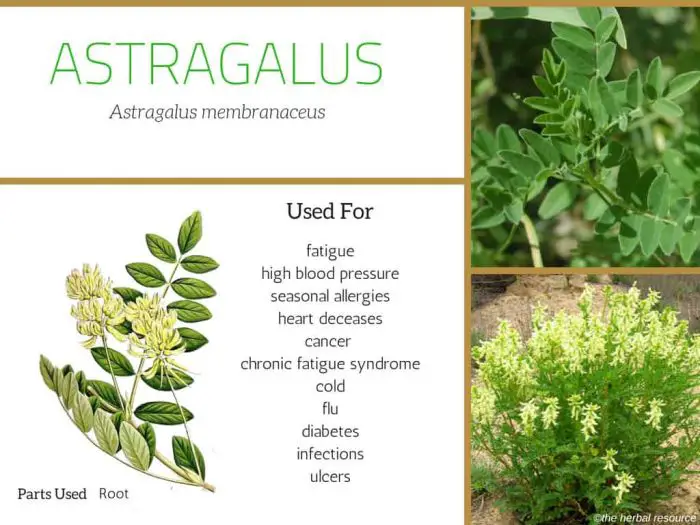
What is Astragalus Used For?
Astragalus is a medicinal herb, and its root is readily available as a herbal supplement in many health stores today.
It is used for many conditions, either on its own or in combination with other herbs. Most of its benefits and uses are based on traditional and long medicinal use.
Scientific evidence has substantiated some of the herbs application for few conditions, but more studies and clinical trials are needed to understand and confirm its effectiveness fully.
Astragalus root has been used, e.g., for the following conditions:
- fatigue
- high blood pressure
- seasonal allergies
- heart deceases
- cancer (to reduce the side effects associated with conventional cancer treatment)
- chronic fatigue syndrome
- cold
- flu
- diabetes
- infections
- ulcers
Traditional Uses
The plant is used as an herbal treatment for physical exhaustion and as a general energy tonic, though it is less well-known than ginseng remedies.
It is often combined with ginseng to treat general fatigue or fatigue associated with conditions such as chronic fatigue syndrome, infections such as candidiasis and herpes simplex virus, mononucleosis and hypoglycemia.
Saponins present in the astragalus root have anti-inflammatory and anti-hypertensive functions. They also make this herb a natural diuretic useful in treating fluid retention disorders including edema.
This herb has been used as a natural remedy for prolapsed organs, particularly the uterus. It has been found to be beneficial in cases of uterine bleeding or excessive bleeding during the menstrual cycle.
Astragalus has also been used traditionally as an herbal remedy for arthritis, asthma, nervous conditions, Hodgkin’s disease, shortness of breath, persistent infections, fever, some allergies, systemic lupus erythematosus, anemia (when combined with Chinese angelica), kidney disease, hepatitis, stomach ulcers and general digestive disturbances such as gas, bloating and diarrhea.
Astragalus Uses for Cancer Treatment and as an Immune System Booster
There is considerable research on the herb’s ability to support the body’s immune system, particularly in cancer patients.
Studies have shown that cancer patients undergoing chemotherapy or radiation therapy recover faster, have prolonged life expectancy and are better able to withstand the side effects of modern cancer treatments when given astragalus. 1
It is thought that the presence of saponin, polysaccharides (astragalin I, II and III) and triterpenes in this herb encourage the bone marrow to produce more white cells as well as enhance white blood cell function. Astragalus may also increase the effects of platinum-based chemotherapy drugs such as cisplatin. 2
Astragalus root is regarded to have antiviral and antibacterial properties. It is thought it may stimulate the body to produce interferons, which are proteins that trigger the immune system to respond to a foreign invasion.
This herb is therefore sometimes used to enhance the body’s defenses against infection and disease, and it is thought to be useful as a preventative treatment during cold and flu season.
Astragalus Root May Help Protect the Heart
This herb contains antioxidants, which may protect cells against damage by free radicals.
It has been theorized that the plant’s antioxidants content can make it useful as a treatment (in conjunction with conventional therapy) for people with severe forms of heart disease.
It was used to treat patients suffering from Coxsackie B viral myocarditis, and it was found that these patients had improved natural killer cell activity. It may be beneficial in the repair of the heart muscle. 3
Active Substance and Constituents
Astragalus contains asparagine, calycosin, formononetin, astragaloside, kumatakenin, sterols, polysaccharides (astragalin I, II and III), saponins (astramembrannin I and II) and Betanin.
Alos, the root contains the isoflavones afrormosin, calycosin, formononetin, and odoratin.
Standardized products usually contain at least 0.5% of a specific complex of isoflavones.
Plant Parts Used
It is mainly the root that is used in herbal medicine, but the above-ground parts of the plant have also been used.
The roots are harvested in the autumn (sometimes spring) from, at least, four-year-old plants They are then sliced and dried for later used as powder, tinctures, and extracts.
Dosage and Administration
Astragalus root is available as a decoction, tincture, tablets or capsules, topically and even in injectable forms in Asian clinical settings.
As a tea: Tea is made from 3 to 6 grams of dried root per 12 oz of water. The mixture should be boiled for five minutes and allowed to steep a further 20 minutes.
As a tincture: Prepare tincture in a 1:5 ratio, in 30 percent ethanol and 3-5 mL should be taken three times daily.
Make an ointment for topical use with a concentration of 10 percent astragalus.
Supplements generally contain 500 mg and two to three tablets, or capsules are usually the recommended daily dosage. The manufacturers’ instructions should always be followed.
Possible Side Effects and Interactions of Astragalus Root
Astragalus has few side effects at low to moderate doses.
Its safety for use among pregnant or nursing women as well as children is unknown so should be avoided.
The reported side effects of this medicinal herb include belly bloating, loose stools, low blood pressure and dehydration.
erature.
This herb does interact with some other herbs and prescription medications, including antihypertensives and immune suppressants. People who have had transplant surgery should not take astragalus due to its immune-boosting effects.
Astragalus may also interfere with blood clotting and should not be taken if on blood-thinning medications.
People with autoimmune diseases (e.g., rheumatoid arthritis, lupus, Crohn’s disease, multiple sclerosis, psoriasis and type 1 diabetes) should consult a doctor before using this medicinal herb.
Other Common Names
- Chinese milkvetch
- Chinese astragalus
- Yellow vetch
- Milk vetch root
- Chinesischer Tragant (German)
- Huang qi (Chinese)
- Astragálo (Spanish)
- Astragale (French)
- Kinaveddel (Swedish)
- Astragel (Danish)
- Kurjenherne (Finnish)
Habitat
This medicinal plant is native to northern and eastern parts of China, as well as Japan, Mongolia, and Korea.
It grows along forest margins, on grassy hills and in shrub thickets along hillsides, but it is also found in thin open woods. It thrives in sandy, well-drained soil and full exposure to sunlight.
Description
The genus Astragalus is one of the largest groups of flowering plants and belongs to the legume family, Fabaceae (peas and beans).
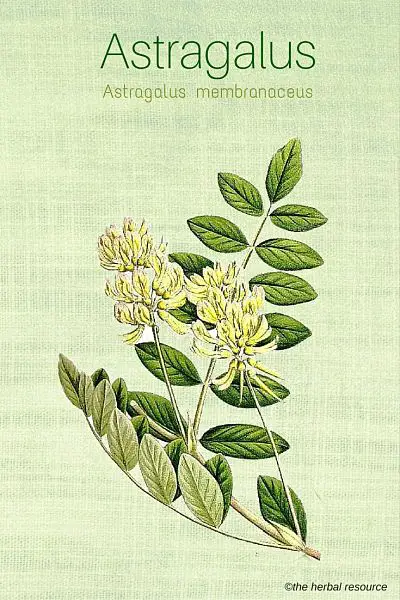
This plant is a twining, multi-branching perennial that reaches 16 to 36 inches in height.
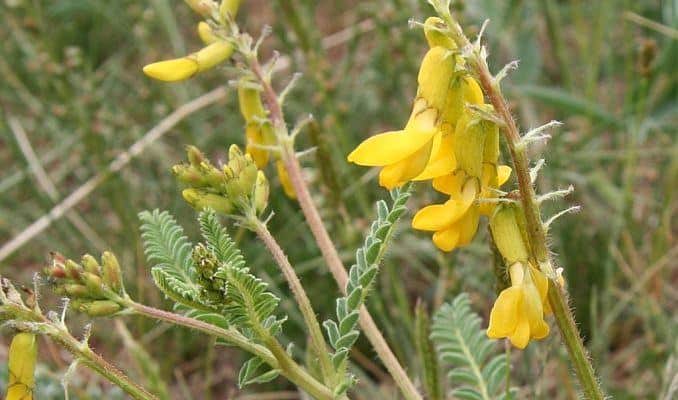
The stems are somewhat hairy, and the pinnate leaves are made up of 12 to 18 pairs of elliptical leaflets. Each plant produces three to nine flowers, which give rise to spindle-shaped pods just over an inch long with beaked tips.
Astragalus has a long flexible root equivalent in diameter to a forefinger. The root is covered by a tough, wrinkled, yellowish to brown skin, which can break out into many wooly fibers.
The root pulp is woody and yellowish to white and has a faint and slightly sweet taste that’s reminiscent of licorice root.
Supporting References
Weed, Susun S.: Breast Cancer? Breast Health!. The Wise Woman Way. Woodstock, New York. Ash Tree Publishing 1996.
Shirataki Y, Takao M, Yoshida S, Toda S. Antioxidative components isolated from the roots of Astragalus membranaceus Bunge (Astragali Radix). Phytother Res . 1997;11:603-605.
Balch, Phyllis A.: Prescription for Herbal Healing. New York, Avery 2002.
Tierra, Michael & Lesley Tierra: Chinese Traditional Herbal Medicine. Vol. 2. Materia Medica and Herbal Resource. Twin Lakes, Wisconsin. Lotus Press 1998.
Tierra, Michael: The Way of Herbs. New York. Pocket Books 1998.
Bensky, Dan & Andrew Gamble: Chinese Herbal Medicine. Materia Medica. Seattle, Washington, Eastland Press Inc. 1993.
ResearchGate – A Review of Recent Research Progress on the Astragalus Genus
Chopra, Deepak & David Simon: The Chopra Center Herbal Handbook. New York, Three Rivers Press 2000.
Sinclair, Steven, N.D. L.: Chinese Herbs: A Clinical Review of Astragalus, Ligusticum, and Schizandrae. Alternative Medicine Review. Volume 3, Number 5, p 344. 1998
Foster, Steven and Yue Chongxi: Herbal Emissaries: Bringing Chinese Herbs to the West. Rochester, Vermont. Healing Arts Press 1992.
McCaleb, Robert, Evelyn Leigh & Krissta Morien: The Encyclopedia of Popular Herbs. Roseville, California. Prima Health 2000.
Mills, Simon & Kerry Bone: Principles and Practice of Phytotherapy. London. England. Churchill Livingstone 2000.


Thordur Sturluson
Latest posts by Thordur Sturluson (see all)
- What is the Difference Between Hemp and Marijuana? - June 3, 2019

I am on Metformin 500 mg twice a day. Is Astragalus safe to take with it??
Also treated and within levels of high blood pressure with Atenolol / Chlorthalidone 50/25 1 in A.M.
Also – Lisinopril 40 mg I tablet in P.M.
Does astragalus interact with Plaquenil/ hydroxychlorquine?