Botanical Name: Turnera diffusa.
Other Common Names
- Damiane,
- Oreganillo
- The bourrique
- Mexican damiana
- Mexican holly
- Damiana de Guerrero
- Damina.
Habitat
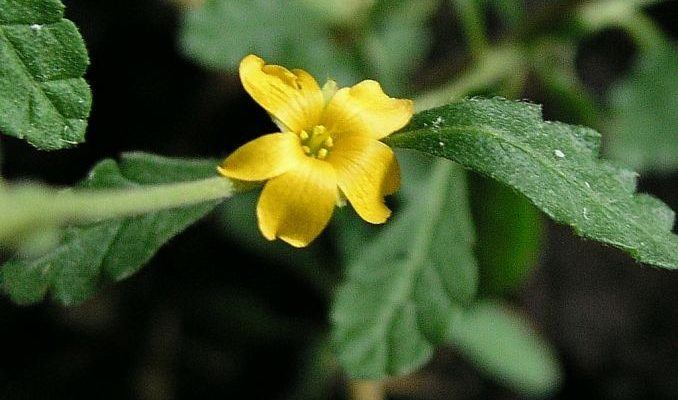
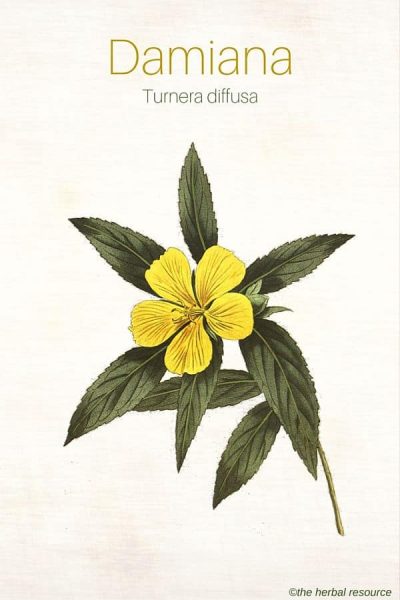
Damiana is a small shrub with aromatic leaves that grows in Mexico, Central and South America, and the West Indies.
Although it is still found in the wild in certain areas, most of the damiana used in herbal remedies today comes from Mexican and Latin American herb ranches.
Plant Parts Used
The leaves of the damiana plant are used for medicinal purposes. They are usually dried but can be used fresh as well.
The dried herb is used as a tea or tincture, or it can be smoked or burned as incense.
Therapeutic Uses, Benefits and Claims of Damiana
The leaves contain substances like essential oil, resins, tannins, starch, arbutin, barterin and a bitter substance known as damianin. (1)
Damiana has been shown to help boost energy and reduce the effects of exhaustion.
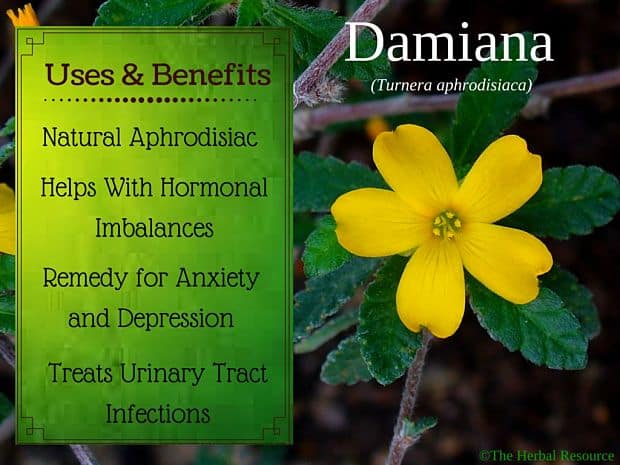
This herb is traditionally been used as an aphrodisiac. Modern research supports this use as well. It is shown to increase sperm count in males and the strength of eggs in females, help with erectile dysfunction and anorgasmia.
It has also been shown to help increase blood flow and stimulation in sexual organs. (2)
Damiana has anti depressant properties and helps to boost the overall mood and bring about a general feeling of well-being. (3)
Additionally, it has been used as an herbal remedy for anxiety. (4)
This medicinal herb is thought to have hormonal balancing properties. It is used to help with the hormonal imbalances common with menopause in women. (5)
It has been used as a central nervous system depressant to help with CNS disorders and modify and control the nervous response.
Damiana has both diuretic and antiseptic properties and has been used as an herbal treatment for urinary tract infections such as bladder and ureteral inflammation.
This effect is partly due to the substance arbutin found in the plant, which is converted to hydroquinone (a powerful antiseptic) in the ureters. Arbutin is also found in many other plants such as bearberry (Arctostaphylos uva-ursi). (6)
The herb is a mild laxative and can be useful in the treatment of constipation due to relaxed gastrointestinal muscles.
It is used in folk medicine to treat asthma and bronchitis, particularly in Indian herbal medicine.
Dosage and Administration
Damiana can be administered in an infusion of the dried leaves, as a fluid extract from the leaves or a capsule of the crushed dry leaves.
Customary daily dosages are:
Infusion: 1 cup of the infusion two to three times daily.
Fluid extract: 2 to 4milliliters twice daily.
Capsules: 3 to 4 grams twice daily.
Possible Side Effects and Interactions of Damiana
Damiana is relatively safe in regular doses although the long-term effects of its use have not been tested.
It does have a traditional background as an abortive, so it is recommended that pregnant women should stay clear of it.
The herb’s safety in children has not been tested so don’t give it to children.
Damiana does have a mild hypoglycemic effect so those on diabetes medication or those who suffer from hypoglycemia must use this plant with caution.
It may interfere with the body’s absorption of iron, so iron levels should be monitored while on this herb.
Supporting References
- Kumar, S., Madaan, R., & Sharma, A. (2008). Pharmacological evaluation of Bioactive Principle of Turnera aphrodisiaca. Indian journal of pharmaceutical sciences, 70(6), 740–744. doi:10.4103/0250-474X.49095
- Kotta, S., Ansari, S. H., & Ali, J. (2013). Exploring scientifically proven herbal aphrodisiacs. Pharmacognosy reviews, 7(13), 1–10. doi:10.4103/0973-7847.112832
- Heiner, Felix & Feistel, Bjoern & Appel, Kurt. (2018). Influence of traditional Turnera diffusa var. aphrodisiaca (Damiana) extract on monoamine-and glutamate receptor-mediated neurotransmission.
- Kumar, S., & Sharma, A. (2005). Anti-anxiety Activity Studies on Homoeopathic Formulations of Turnera aphrodisiaca Ward. Evidence-based complementary and alternative medicine : eCAM, 2(1), 117–119. doi:10.1093/ecam/neh069
- (2005) The Genus Turnera.: A Review Update,Pharmaceutical Biology, 43:5, 383-391, DOI: 10.1080/13880200590962926
- (2006) Apigenin: The Anxiolytic Constituent of Turnera aphrodisiaca.,Pharmaceutical Biology, 44:2, 84-90, DOI: 10.1080/13880200600591758
Supporting References – Offline
van Wyk, Ben-Erik & Michael Wink: Medicinal Plants of the World. Portland, Oregon, Timber Press 2004.
Rätsch, Christian: The Encyclopedia of Psychoactive Plants. Ethnopharmacology and its Applications. Rochester, Vermont, Park Street Press 2005.
Rätsch, Christian: Plants of Love. Aphrodisiacs in History and a Guide to Their Identification. Berkeley, Ten Speed Press 1997
Atkins, Rosie, et al.: Herbs. The Essential Guide for a Modern World. London, Rodale International Ltd. 2006.
Blumenthal, Mark: The Complete German Commission E Monographs. Austin, Texas, American Botanical Council 1998.
Gruenwald, Joerg et al.: PDR for Herbal Medicines. 4th Ed. Montvale, New Jersey, Thomson Healthcare Inc. 2007.


Thordur Sturluson
Latest posts by Thordur Sturluson (see all)
- What is the Difference Between Hemp and Marijuana? - June 3, 2019
Leave a Reply