A fungus is an ever-present microbe in and on the human body and most of the time there is no harm in its presence.
However, there are times when conditions in the skin or gut change and allow prolific growth of certain fungal species, which can cause irritation and discomfort.
Those changes can be hormonal as in the case of pregnancy, or a result of conventional medications such as antibiotics and oral contraceptives.
A change in the skin’s pH level as a result of some cosmetics, or an increase in the skin’s moisture, perhaps as a result of sweating, can also prompt a proliferation of fungus.
Even changes in diet or exhaustion can cause the imbalance needed to allow a fungal infection to develop. Fungal infections can break out anywhere on the body, but the most common regions are the feet, groin area, fingernails and toenails, scalp and vagina.
There are many medicinal herbs with antifungal properties that can be used to effectively treat fungal infections. Evidence and observations by herbalists suggest that using mixtures of anti-fungal herbs is more effective than using any one anti-fungal in isolation.
Along with medicinal herbs and conventional treatments, fungal infections can be prevented by maintaining a healthy diet and balanced lifestyle.
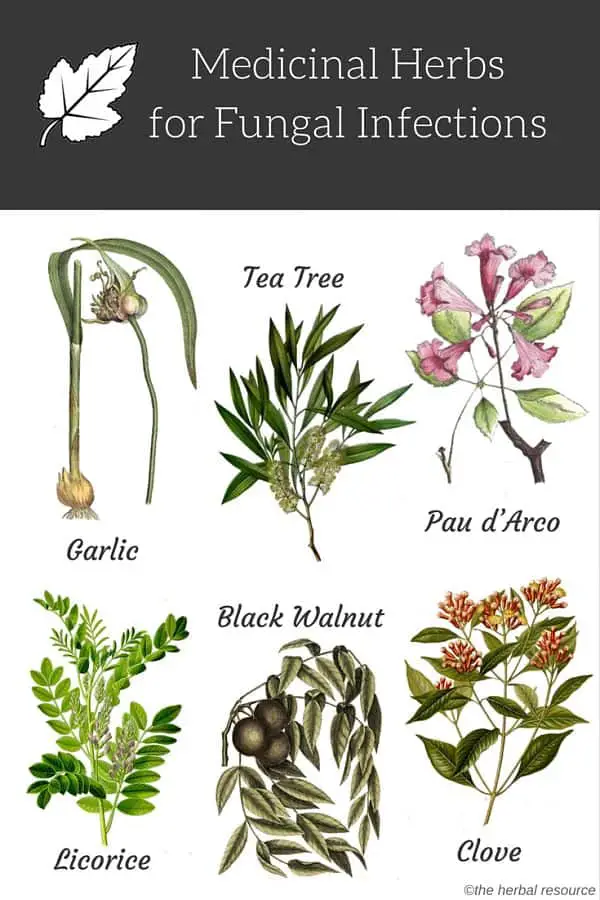
Medicinal Herbs Used for Treating Fungal Infections
Black Seed Oil (Nigella sativa)
Black seed oil can act as a natural antibiotic. Its antimicrobial and anti-bacterial properties are strong enough to ward of bacterial infections.
Garlic (Allium sativum)
Ajoene is a constituent of garlic that is thought to be almost as effective against mildew fungus as pharmaceutical antifungal medications. Garlic extract can be ingested, but it is more potent when used topically.
Black Walnut (Juglans nigra)
Evidence suggests black walnut could be more effective in treating Candida than some commonly prescribed antifungal drugs. The active ingredients include linolenic acid, sterols, tannins, quinone, and iodine. This medicinal herb also relieves constipation, which is commonly associated with Candida overgrowth.
Tea Tree Oil (Melaleuca alternifolia)
Candida albicans, the yeast responsible for thrush and vaginal yeast infections are particularly susceptible to tea tree oil.
Calendula (Calendula officinalis)
Calendula is a common herbal remedy for thrush, diaper rash, athlete’s foot and ringworm. The essential oil can even be used in a suppository to treat vaginal yeast infections.
Licorice (Glycyrrhiza glabra)
Licorice root contains 25 fungicidal compounds, which is more than any other herb, yet it is not well-known as an antifungal herb.
Chamomile (Matricaria recutita)
This medicinal herb is may be effective against the yeast candida and as a result, is often incorporated into over-the-counter antiseptics in Europe.
Pau d’Arco (Tabebuia impetiginosa)
Pau d’arco contains three antifungal compounds: lapachol, beta-lapachone and xyloidine. When prepared as a tea, it can be taken internally but can also be applied topically by soaking a cloth in the tea to make a compress.
Guajava (Cassia alata)
This herb contains anthraquinones, which demonstrate antifungal properties. It is often used as a natural treatment for ringworm.
Clove (Syzygium aromaticum)
The flower buds from the clove tree contain the compounds carvacrol and thymol, which have strong antifungal properties. Clove oil can be used to treat fungal infections of the fingernails and toenails.
Oregano (Origanum vulgare)
The oil of oregano contains carvacrol and thymol, which work together as an effective anti-infectious agent. This herb is a natural remedy for treatment ofdandruff and dermatitis.
Goldenseal (Hydrastis canadensis)
Goldenseal contains berberine, which is a powerful antifungal and antibacterial that is also found in barberry, goldthread, Oregon grape, and yellowroot.
Treatment with these medicinal herbs is particularly effective as berberine treats the infecting fungus while leaving beneficial microflora in the gut intact. Berberine is thought to prevent yeasts from producing lipase, an enzyme critical to colonization.
Other natural herbs that have been used to treat fungal infections.
- Turmeric (Curcuma longa)
- Chaparral (Larrea tridentata, Larrea mexicana)
- Rosemary (Rosmarinus officinalis)
- Cinnamon (Cinnamomum verum)
- Acerola (Malpighia emarginata)
- Burdock (Arctium lappa)
- Cat’s Claw (Uncaria tomentosa)
- Echinacea (Echinacea angustifolia, Echinacea purpurea)
- Fenugreek (Trigonella foenum-graecum)
- Figwort (Scrophularia nodosa)
- Curly-cup Gumweed (Grindelia squarrosa)
- Henna (Lawsonia inermis)
- Lavender ( Lavandula angustifolia, Lavandula officinalis)
- Lemongrass (Cymbopogon citratus)
- Myrrh (Commiphora molmol)
- Poke Root (Phytolacca decandra)
- Sage (Salvia officinalis)
- Thyme (Rumex crispus)
- Usnea (Usnea florida) – a lichen
- Yarrow (Achillea millefolium)
- Yellow Dock (Rumex crispus)
- Blackberry (Rubus fruticosus)
- Nasturtium (Tropaeolum majus)


Thordur Sturluson
Latest posts by Thordur Sturluson (see all)
- What is the Difference Between Hemp and Marijuana? - June 3, 2019

Hello,
I’m afraid your statement that there is no harm from fungus in the body is incorrect.
I’d like to share information I learned during my workplace’s outbreak of an airborne infectious disease that can cause malignancies, precancerous conditions, rheumatic diseases, connective tissue diseases, autoimmune symptoms, inflammation in any organ/tissue, seizures, migraines, hallucinations, etc.
My coworkers and I, all immunocompetent, got Disseminated Histoplasmosis in Dallas-Fort Worth from roosting bats, the most numerous non-human mammal in the U.S., that shed the fungus in their feces. The doctors said we couldn’t possibly have it since we all had intact immune systems. The doctors were wrong.
More than 100 outbreaks have occurred in the U.S. since 1938, and those are just the ones that were figured out since people go to different doctors. One outbreak was over 100,000 victims in Indianapolis. 80-90+% of people in some areas have been infected. It can lay dormant for up to 40 years in the lungs and/or adrenals.
This pathogen parasitizes the reticuloendothelial system/invades macrophages, infects and affects the lymphatic system and all tissues/organs, causes inflammation and granulomas, etc. It causes idiopathic (unknown cause) diseases and conditions, including hematological malignancies, autoimmune symptoms, myelitis, myositis, vasculitis. etc. It causes hypervascularization, calcifications, sclerosis, fibrosis, necrosis, eosinophilia, leukopenia, anemia, neutrophilia, pancytopenia, thrombocytopenia, hypoglycemia, cysts, abscesses, polyps, stenosis, and perforations, GI problems, hepatitis, focal neurologic deficits, etc. Many diseases it might cause are comorbid with other diseases it might cause, for example, depression/anxiety/MS linked to Crohn’s disease.
It at least “mimics” autoimmune diseases, cancer, mental illness, migraines, seizures, etc. It’s known to cause rheumatological conditions. It causes hematological malignancies, and some doctors claim their leukemia patients go into remission when given antifungal. My friend in another state who died from lupus lived across the street from a bat colony. An acquaintance with alopecia universalis and whose mother had degenerative brain disorder has bat houses on their property.
Apparently, even the CDC didn’t know bats CARRY it and shed it in their feces, although they knew it could grow in bird and bat feces. Researchers claim the subacute type is more common than believed. It is known to at least mimic autoimmune diseases and cancer and known to give false-positives in PET scans. But no one diagnosed with an autoimmune disease or cancer is screened for it. In fact, at least one NIH paper states explicitly that all patients diagnosed with sarcoidosis be tested for it, but most, if not all, are not. Other doctors are claiming sarcoidosis IS disseminated histoplasmosis.
The fungus is an Oxygenale and therefore consumes collagen. It’s known to cause connective tissue diseases. Fungal hyphae carry an electrical charge and align with a current. It causes RNA/DNA damage. It’s known to cause delusions, wild mood swings, and hallucinations. It’s most potent in female lactating bats because the fungus likes sugar (lactose) and nitrogen (amino acids, protein). What about female lactating humans…postpartum psychosis? The bats give birth late spring/summer, and I noticed suicide rates spike in late spring/early summer. A map of mental distress and some diseases appear to almost perfectly overlay a map of Histoplasmosis. Johns Hopkins linked autism to an immune response in the womb. Alzheimer’s was linked to hypoglycemia, which can be caused by chronic CNS histoplasmosis. The bats eat moths, which are attracted to blue and white city lights.
I believe the “side effects” of Haldol (leukopenia and MS symptoms) might not always be side effects but just more symptoms of Disseminated Histoplasmosis, since it causes leukopenia and MS symptoms. What about the unknown reason why beta receptor blockers cause tardive dyskinesia? The tinnitus, photophobia, psychosis “caused” by Cipro? The hypersexuality and leukemia “caused” by Abilify? Humira linked to lymphoma, leukemia, and melanoma in children? etc.
From my experience, I learned that NO doctor, at least in DFW, will suspect subacute and/or progressive disseminated histoplasmosis in immunocompetent people. Some doctors, at least the ones I went to, will even REFUSE to test for it, even when told someone and their coworkers have all the symptoms and spend a lot of time in a building with bats in the ceiling. Victims will be accused of hypochondriasis. In fact, the first doctor to diagnose me was a pulmonologist, and the only reason he examined me was to try to prove that I didn’t have it when I really did. No doctor I went to realized bats carry the fungus. And NO doctor, at least none in DFW, even infectious disease “experts,” understand the DISSEMINATED form, just the pulmonary form, and the only test that will be done by many doctors before they diagnose people as NOT having it is an X-ray, even though at least 40-70% of victims will have NO sign of it on a lung X-ray. It OFTEN gives false-negatives in lab tests (some people are correctly diagnosed only during an autopsy after obtaining negative test results) and cultures may not show growth until after 12 weeks of incubation (but some labs report results after 2 weeks).
One disease of unknown cause that could be caused by Disseminated Histoplasmosis: I suspect, based on my and my coworker’s symptoms (during our “rare” infectious disease outbreak) and my research, that interstitial cystitis and its comorbid conditions can be caused by disseminated histoplasmosis, which causes inflammation throughout the body, causes “autoimmune” symptoms and is not as rare as believed. I read that “interstitial cystitis (IC) is a chronic inflammatory condition of the submucosal and muscular layers of the bladder, and the cause is currently unknown. Some people with IC have been diagnosed with other conditions such as irritable bowel syndrome (IBS), fibromyalgia, chronic fatigue syndrome, allergies, and Sjogren’s syndrome, which raises the possibility that interstitial cystitis may be caused by mechanisms that cause these other conditions. In addition, men with IC are frequently diagnosed as having chronic nonbacterial prostatitis, and there is an extensive overlap of symptoms and treatment between the two conditions, leading researchers to posit that the conditions may share the same etiology and pathology.” Sounds like Disseminated Histoplasmosis, doesn’t it?
My coworkers and I had GI problems, liver problems, weird rashes (erythema nodosum, erythema multiforme, etc.), plantar fasciitis, etc., and I had swollen lymph nodes, hives, lesions, and started getting migraines and plantar fasciitis in the building, and haven’t had them since I left. It gave me temporary fecal incontinence, seizures, dark blood from my intestines, nystagmus, benign paroxysmal positional vertigo, various aches and pains (some felt like pinpricks and pinches), tingling, tremors, and chronic spontaneous “orgasms”/convulsions. Suddenly I was allergic to pears (latex-fruit allergy?). I had insomnia (presumably from the fungus acidifying the blood, releasing adrenaline) and parasomnias. I suddenly had symptoms of several inflammatory/autoimmune diseases, including Fibromyalgia, Sarcoidosis, ALS, MS, Sjogren’s syndrome, etc. that have disappeared since leaving the area and taking nothing but Itraconazole antifungal.
No one, including doctors, could figure out what was wrong with us, and I was being killed by my doctor, who mistakenly refused to believe I had it and gave me progressively higher and higher doses of Prednisone (at least 2 years after I already had Disseminated Histoplasmosis) after a positive ANA titer, until I miraculously remembered that a visiting man once told my elementary school class that bats CARRY histoplasmosis….so much of it that they evolved to deal with the photophobia and tinnitus it causes by hunting at night by echolocation. There’s a lot more. I wrote a book about my experience with Disseminated Histoplasmosis called “Batsh#t Crazy,” because bats shed the fungus in their feces and it causes delusions and hallucinations, I suspect by the sclerotia it can form emitting hallucinogens (like psilocybin and dimethyltryptamine) along with inflammation in the CNS. (Schizophrenics have 2X of a chemical associated with yeast, part of the fungal life cycle.)
Thank you for your time,
Susan McIntyre
Miss McIntyre is correct! I’ve seen a common finger nail fungus turn into a full blown interal fungus that can rob one of mental capacity, organ functioning capacity, increase over aging, and cause intestinal troubles that can cause malnutrition etc. It can literally kill you.
I like the helpful info you supply for your articles. Keep up the great work!
Thank you for the great info.
I like to have more info about fungai in the body, concentrated in the gut.
The fungus in my body shows in my 3 toenails and dont go away. I need to clean the body from fungai in order to heal my toe nails.
Are there combination of herbas that can be taken for a while safely till body is cleansed ftom fungai?Silvia.
I deparasiting myself in a few days. But fungai has me worried!