Botanical Name: Viscum album.
Other Common Names: European, Christmas and oak mistletoe, druid’s herb, golden bough, holy wood, the kissing bush, herbe de la croix (French), Weissbeerige Mistel (German), muerdago (Spanish), mistelten (Danish), mistilteinn (Icelandic).
Habitat: Viscum album grows in Europe, northwest Africa, and central Asia and Japan.
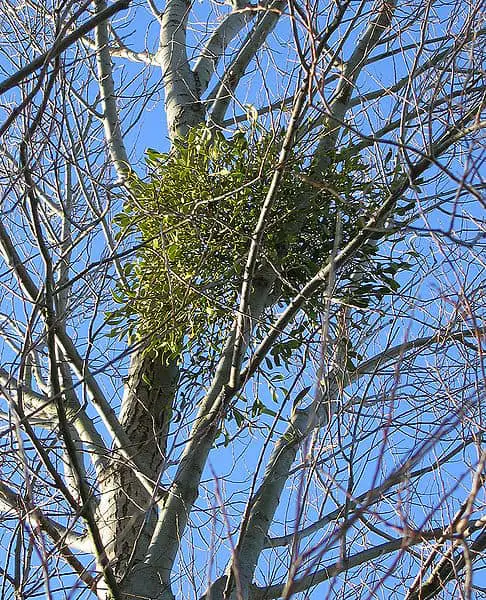
It is a perennial, semi-evergreen parasitic plant, growing on the branches of trees.
It is most commonly seen on old apple, ash, and hawthorn trees; although mistletoe does not grow as well on oak trees, mistletoe from oak trees has traditionally been the most commonly used as herbal medicine.
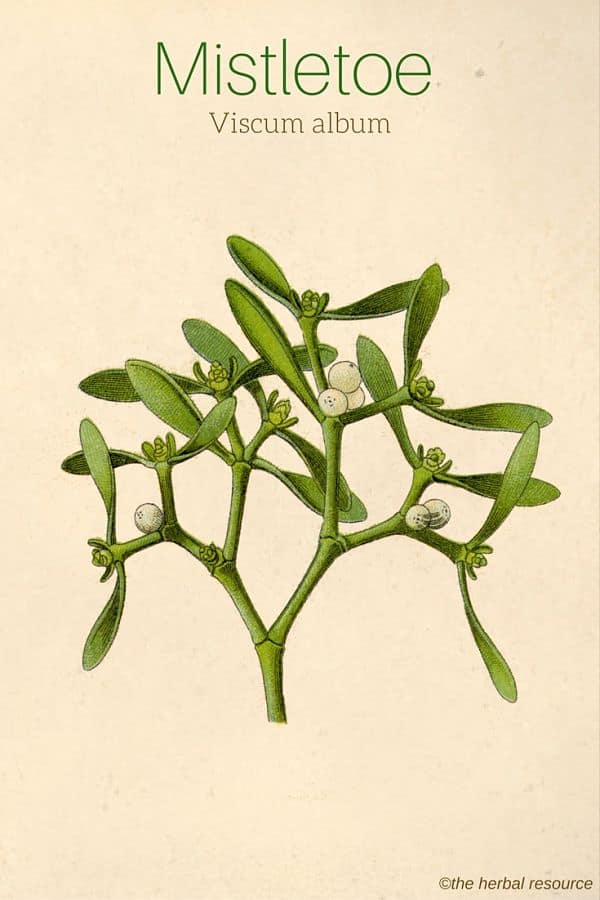
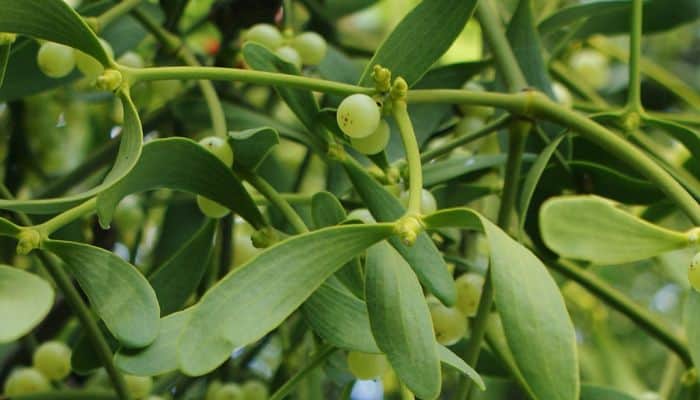
Description: Mistletoe has opposite, thick, leathery leaves that are oval or lance-shaped and about two inches long. These form a drooping yellowish evergreen bush about 2-3 feet long on the branch of a host tree. It has densely crowded branches with oval to lance-shaped leaves about 2 inches long.
The flowers, in compact spikes, are bisexual, unisexual, or regular. They are yellower than the leaves and appear in the late winter. These become one-seeded, white berries, which when ripe are filled with a sticky, semi-transparent pulp. The seeds are eaten by birds and spread by them to other trees.
Plant Parts Used: Leaves and stems.
Therapeutic Uses, Benefits and Claims of Mistletoe
The active constituents present in the plant are mistletoe lectins I, II and III (glycoprotein); viscotoxin (protein); galacturonan, arabinogalactan (polysaccharides), and alkaloids.
Mistletoe was a sacred plant of the Celtic peoples; the Celts and Gauls called it “all-heal” or “cure-all”.
Shakespeare called mistletoe ‘baleful Mistletoe’, a reference to the Nordic mythology when Baldur, the god of peace and beauty, was slain by an arrow made from mistletoe and then brought back to life by the other Nordic gods.
Mistletoe is used by traditional herbalists as a nervine, antispasmodic, tonic and narcotic and European herbalists considered it to be a specific remedy for St. Vitus’s Dance, epilepsy and other convulsive nervous disorders.
It has a long history as an herbal treatment for delirium, hysteria, neuralgia, and nervous debility and mistletoe tincture was used as a heart tonic in typhoid fever.
Herbal practitioners have used this herb as a treatment for urinary disorders, heart disease, and other symptoms arising from a weakened or disordered state of the nervous system.
Mistletoe has been used to lower blood pressure and heart rate, ease anxiety, and as an herbal sleep aid.
The herb was traditionally used throughout Europe as a remedy for headaches, dizziness, loss of energy and irritability.
It has been used as a traditional herbal remedy for the treatment for cough, especially convulsive cough, bronchial asthma, and asthmatic attacks due to psychological tension.
Traditional herbal medicine uses the herb as a natural treatment for arthritic pain and it is believed to be an effective external treatment for leucorrhoea, gout and sciatica.
Numerous studies have reported that the plant lectins, in Viscum album possess toxic, cytotoxic, antitumor, and anticarcinogenic properties.
Research is currently being done in Europe to determine their potential in cancer chemotherapy and in Germany, extracts of European mistletoe is sometimes used as a treatment for certain types of cancer.
In Europe, the plant is used in oncology therapies under the trade names Iscador® and Helixor®.
The German Commission E has approved it as a treatment for degenerative and inflamed joints and as a palliative therapy for malignant tumors.
The closely related species American mistletoe (Phoradendron leucarpum) is rarely used medicinally. Some herbalists believe that it has an opposite effect from the European mistletoe (Viscum album).
However, both the American and European species contain toxic proteins which are similar in their chemical composition and produce similar side effects, including hypotension, bradycardia, and vasoconstriction in test animals.
American mistletoe often called false or oak mistletoe is believed by some herbalists to stimulate smooth muscles, causing a rise in blood pressure and increased uterine and intestinal contractions.
Native Americans used American mistletoe as a treatment for paralysis, and it was also used as an oral contraceptive and to stop bleeding after childbirth.
Dosage and Administration
Mistletoe is used as dried leaves, capsules, infusion, liquid extract, and tincture.
As dried leaves: 2-6 grams taken orally three times daily.
]As liquid extract: 1:1 solution in 25% alcohol, 1-3 millilitres orally three times daily.
As a tincture: 1:5 solution in 45% alcohol, 0.5 milliliter orally three times daily.
For external use: one part tincture to five parts water. For gout and sciatica, tincture compresses are used on the affected areas daily for one hour.
Side Effects and Possible Interactions of Mistletoe
All species of mistletoe are not recommended for the home herbalist and are best left to professional practitioners.
While there are valuable medicinal uses for this herb, all parts of the plant are acutely toxic and there are much safer and less toxic choices available to the home herbalist to treat the same conditions.
The berries are considered to be especially toxic.
It should be avoided during pregnancy or breastfeeding, as it may stimulate uterine contractions.
Possible side effects include a change in pupil size, mild fever, dehydration from diarrhea, slow pulse, hallucinations, nausea, delirium, or seizures.
This herb should not be used while consuming alcohol or taking drugs that slow the nervous system, such as cold and allergy drugs, sedatives, tranquilizers, narcotic pain relievers, barbiturates, seizure drugs, and muscle relaxants.
The use of mistletoe should be avoided with drugs that lower blood pressure, or with drugs to relieve depression (called MAO inhibitors, such as Marplan and Nardil).
The herb should not be used along with heart medications as the combination creates an increased risk of cardiac slow-down. Any use of the herb should always be under the guidelines of a professional healthcare provider.
Supporting References
Wilkens, Johannes & Gert Böhm: Misteltoe Therapy for Cancer: Prevention, Treatment and Healing. Edinburgh, Scotland. Floriss Books 2010.
Príhoda, Antonín, Ladislav Urban & Vera Nicová: The Healing Powers of Nature. Leicester, England. Blitz Editions 1998.
Paine, Angela: The Healing Power of Celtic Plants. Hants. O Books 2006.
McIntyre, Anne: The Complete Herbal Tutor. London, England. Octopus Publishing Group Ltd. 2010.
Balch, Phyllis A.: Prescription for Herbal Healing. New York. Avery 2002.
Volák, Jan & Jiri Stodola: The Illustrated Book of Herbs. London, England. Caxton Editions 1998.


Thordur Sturluson
Latest posts by Thordur Sturluson (see all)
- What is the Difference Between Hemp and Marijuana? - June 3, 2019

I am looking for a retail outlet to purchase white mistletoe powder for my husband who has prostrate cancer.
My father suffer of Non Hodgkin’s lymphoma cancer, B-cells and I would like to know if he can use the mistletoe to treat the cancer.
Consult with an herbalist about mistletoe as it can cause problems. If your father is taking medication it can be dangerous.
I am taking this from a health coach because I have lung cancer stage 2 and am unable to take chemo. I am on a long list of vitamins, immunotherapy builders, mistletoe tincture which the coach makes, red blood tincture w/ alcohol which he also makes and. The bottle of mistletoe tincture broke so I reordered and it seems to be very foul. It now has green mold or algae growing in the bottle which has colloidal silver in it and I can also taste the alcohol. I know I need to take these tinctures as I have done quite a bit of research and they are considered extremely beneficial for the type of cancers I have had.
I would like to know where I can get the European brands and insure they are blended properly for the cancer. Really would appreciate any assistance you can give me. Interested in the Blood Root and the Mistletoe. Do not feel I should order from this life coach as there obviously is a problem and I did experience quite a few side effects from the tainted tincture.
Thank you in advance for any information you can share.