Botanical Name: Commiphora molmol, Commiphora abbysinica, Commiphora myrrha
The common name “myrrh” means “bitter” in Arabic.
Other Common Names: Myrrh tree, guggal gum, guggal resin, myrrh gum, didthin, mo yao (Chinese), arbol de mirra (Spanish), arbre à myrrhe (French), Echter Myrrhenbaum (German), myrra (Swedish).
Habitat: Native to Ethiopia, Somalia, the eastern Mediterranean, and the Arabian Peninsula. This tree prefers desert regions.
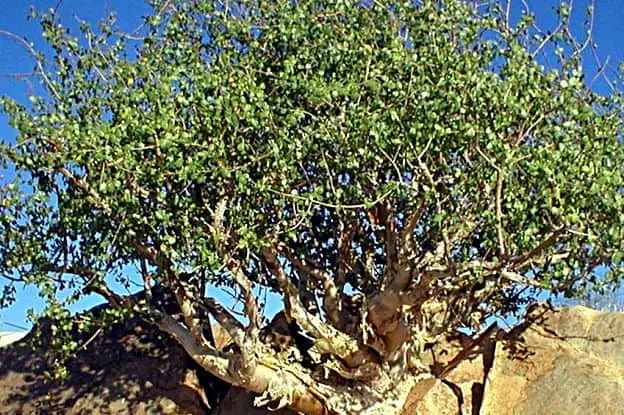
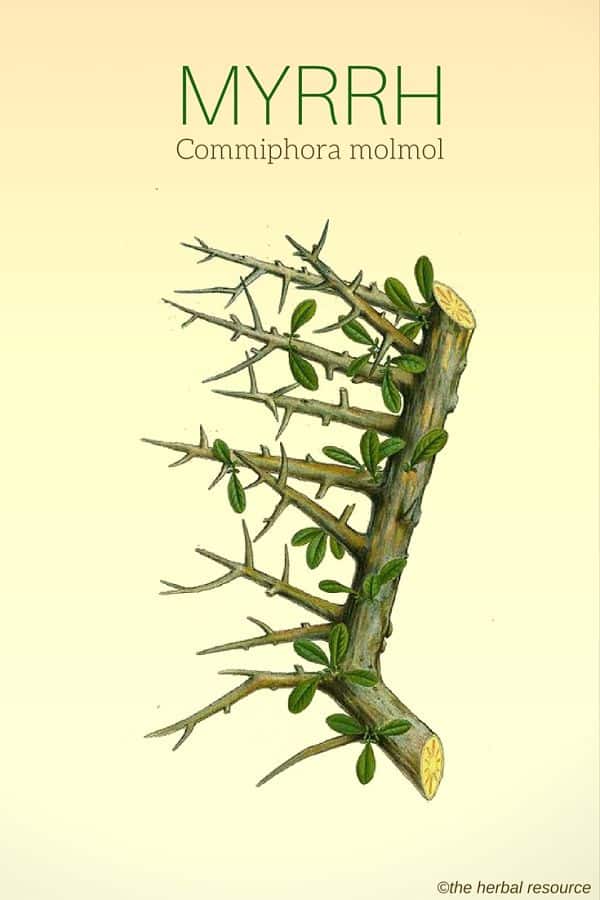
Plant Description: Myrrh is a shrub-like tree that reaches only about nine feet in height. This tree has a thick, light gray trunk with sharp spines protruding from its main branches.
The serrated-edged leaves grow in groups of three consisting of two small, oval leaves and one larger leaf.
Yellowish-red flowers hang in elongated, branching clusters, accompanied by small brown oval fruits.
Plant Parts Used: It is the bitter tasting rubber sap that is used as herbal medicine.
The sap secretes naturally from the bark of the tree and becomes a resin (Myrrh) when it solidifies.
The resin can be distilled to extract an essential oil, pulverized into a powder which can be used in tablets and capsules, or dissolved in ethanol to make a tincture.
The resin is mainly harvested from wild trees in Africa and the Arabian Peninsula. Myrrh resin forms irregular pieces varying in size and color. They are translucent and sometimes covered by a layer of white powder. The color can be white brown, greenish, brownish yellow, reddish yellow, reddish-brown or brown-black.
Therapeutic Uses, Claims and Benefits of Myrrh
Myrrh is traditionally used as burned incense which repels fleas and mosquitoes.
Thought to be effective for pain relief, including menstrual pain resulting from blood stagnation.
Powdered myrrh is used in Germany to treat throat and mouth inflammation.
It is also used on external injuries to reduce swelling. Applied directly to teeth, it can also help ease the pain of a toothache.
The ancient Chinese used this herb to treat wounds and bruises; it is still used as a broad-spectrum antiseptic to treat various ailments like conjunctivitis (pinkeye), cold sores and canker sores.
It is also believed that the use of myrrh promotes healing, making it a popular ingredient in veterinary salves.
Taken internally, myrrh’s antiseptic properties help treat gingivitis and loose teeth, as well as help get rid of bad breath or halitosis.
Because of the antifungal properties of the herb it may be used as an herbal treatment for athlete’s foot, candida and other fungal infections.
It is thought to be a good herb to reduce cholesterol levels, though clinical studies are thus far inconclusive.
Mixed with boric acid and boiling water, myrrh can be used as a gargle for oral inflammation, a sore throat, and gum issues.
Myrrh gargles may also be beneficial in other mouth and throat diseases such as strep throat.
Internally, it has been used as an expectorant and to relieve gastric distress. Additionally, it is used to soothe or relax smooth muscle tissue.
Research is currently underway to confirm possible cancer-fighting properties in myrrh.
Myrrh has antimicrobial properties and is used internally to stimulate macrophage action in the bloodstream.
Dosage and Administration
Myrrh is used powdered, in a capsule, or in tincture form. This is a popular ingredient in dental care products, perfumed body care products, and as a food flavoring.
Dosage varies, though labeling on commercial products should always be adhered to.
A qualified physician will be able to give conclusive information on dosage for the specific ailment being treated for and which form of the herb is the best to use.
For a tincture, powdered myrrh can be added to a 50/50 solution of water mixed with gin, vodka, or brandy. There should be enough alcohol to cover the powdered herb.
Place in a cool, dark place for approximately two weeks, shaking several times daily.
The tincture should then be strained, placed in a dark bottle, and stored away from strong light. Take 1-2 mL three times a day.
An essential oil can be rubbed directly on the chest and throat to relieve the symptoms of bronchitis, or diluted with water or other base and applied directly to sores, bruises, and open wounds.
Side Effects and Possible Interactions of Myrrh
Myrrh should be avoided by pregnant or nursing mothers.
This herb should not be given to children and should be kept out of their reach.
Myrrh may cause irritation of the eyes and mucous membranes. Currently, there are no known interactions or side effects associated with myrrh, but as with any herbal remedy a doctor should be consulted before use.
Supporting References
Bown, Deni: The Royal Horticultural Society New Encyclopedia of Herbs & Their Uses. London, Dorling Kindersley 2002.
A Modern Herbal | Myrrh – Botanical.com
Buchman, Dian Dincin: Ancient Healing Secrets. Avenel, Crescent Books 1996.
Lawless, Julia: The Illustrated Encyclopedia of Essential Oils. Shaftesbury, Element Books 1995.Mabey, Richard:
van Wyk, Ben-Erik & Michael Wink: Medicinal Plants of the World. Portland, Oregon, Timber Press 2004.


Thordur Sturluson
Latest posts by Thordur Sturluson (see all)
- What is the Difference Between Hemp and Marijuana? - June 3, 2019

Myrrh is the only thing that has helped us with painful canker/mouth sores. Those things are so nasty and painful and take so long to heal but Myrrh applied directly few times a day (burns a little) but the results are real and fast! So glad to have tried it!
I was impressed with the variety of medicinal uses and side affects. It has a history of many years and grows in desert climates. The website is well designed and easy to read the information on this sire.