Botanical Name of Wild Yam Root: Dioscorea villosa.
The genus name Dioscorea gets its name from the ancient Greek physician Pedanius Dioscorides. The common name “yam” comes from West African dialect and means “to eat”.
Other Common Names: Colic root, aluka, China root devil’s bones, Mexican wild yam, rheumatism root, yuma, shan yao (Chinese), igname (French), name silvestre (Spanish), Vildjams (Swedish).
Habitat: Wild yam is native to North and Central America. It has become naturalized in many tropical, subtropical and temperate areas around the world.
This perennial, twining vine grows in damp woodlands and thickets. This plant thrives in sunny conditions and rich soil.
Plant Description: Wild yam is a member of the Dioscoreaceae family which contains around 750 species of flowering plants.
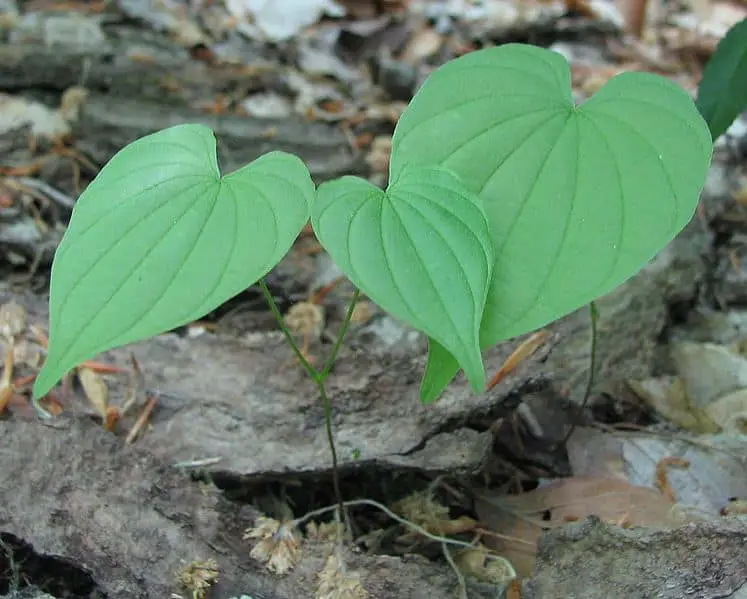
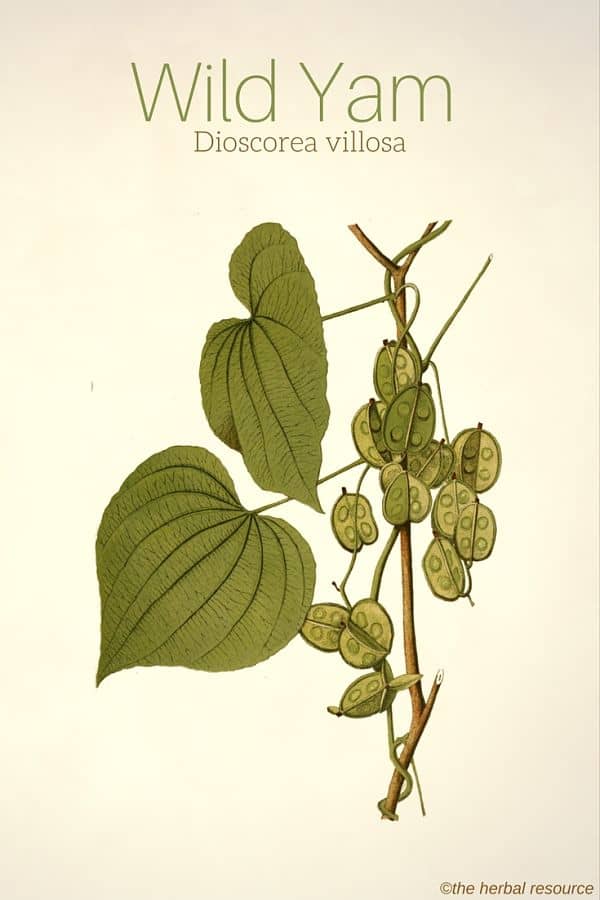
Wild yam is a tuberous, twining vine with pale-brown, knotty, woody, cylindrical tubers. The tubers are crooked and bear horizontal branches. They have a thin reddish stem that grows to a length of over 9.2 meters.
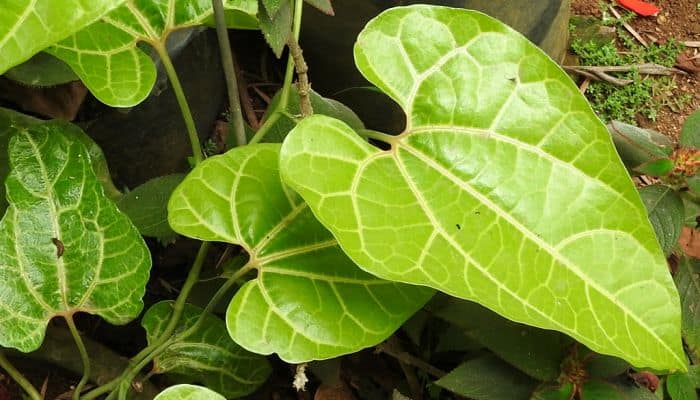
This plant produces clusters of greenish-white or greenish-yellow flowers. The leaves, which are heart-shaped, have a smooth top surface and downy under-surface.
Plant Parts Used: The roots and rhizome are dried and used for medicinal purposes.
Wild yam has gradually become a rare plant in the wild because of overexploitation and today most of the wild yam roots available are commercially cultivated.
Therapeutic Uses, Benefits and Claims of Wild Yam Root
Active Ingredient and Substances: Wild yam contains steroidal saponins (dioscin and diosgenin), phytosterols (beta-sitosterol), alkaloids (dioscorin), tannins, starch, mucins, amylase, amino acids (arginine, glutamine, leucine, tyrosine), chlorine, calcium, chromium, copper, iron and vitamin C.
Traditional Use
Wild yam was used as a medicinal herb by the Mayans and the Aztecs, possibly as a pain treatment.
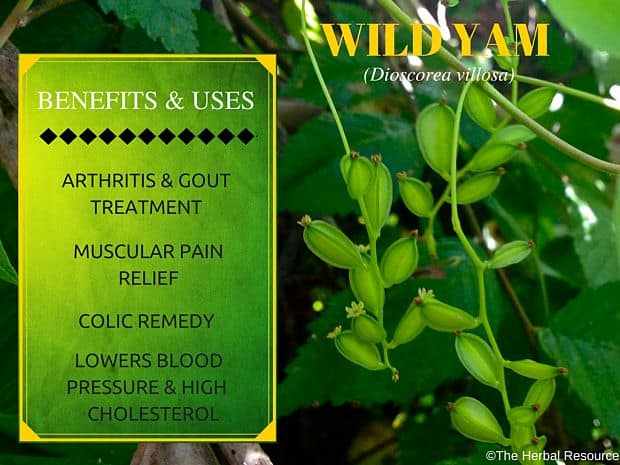
In North America, the herb is also known by the English common names “colic Root” and “rheumatism Root”, suggesting that the Native Americans and the first European settlers primarily used it as a remedy for colic and gout.
The herb has antispasmodic and anti-inflammatory properties which explain the traditional application for treating symptoms of rheumatism and arthritis. These same qualities are thought to make it useful in treating cramps and muscular pain.
It has also been used to treat digestive disorders including gallbladder inflammation, irritable bowel syndrome (IBS), and diverticulitis.
Wild yam has also diuretic and anti-inflammatory effects that might make it helpful as an herbal remedy for urinary tract conditions.
This herb has also been used as a treatment to lower blood pressure (temporarily) and cholesterol levels in the blood.
The root is also thought to be helpful for many ailments related to the spleen, kidneys, lungs, and stomach.
Wild Yam as a Natural Progesterone
Wild yam root has been promoted as a “natural progesterone”. Many herbalists have raised doubts about the practical value of the plant in that regard and concerns relating to possible toxic effects of the herb.
In the past, wild yam root was used as a starting material to synthesize progesterone medications such as cortisone, estrogen and other steroid products.
Wild yam root contains a compound called diosgenin, which is used in birth control pills and other steroid hormones. This has supported the idea that the herb could regulate female sex hormones and be used as an herbal remedy for many of the symptoms associated with menopause.
Diosgenin is technically a “hormone precursor”, meaning that it must be treated chemically in a laboratory in order to have a value as a synthetic version of the sex hormones testosterone and progesterone.
Products containing wild yam root are often marketed with the claims that diosgenin may increase the levels of testosterone, progesterone and other hormone compounds. Similarly, wild yam and diosgenin are promoted as a “natural DHEA”. DHEA (dehydroepiandrosterone ) is naturally produced by the kidneys in humans and is the most common adrenocorticoid hormone in the body.
The fact is that there are complex processes involved when making a steroid hormone such as (DHEA) and it is far from clear that the herb in its natural form, be it as a decoction, tincture or capsule, may have any form of hormone action in the body.
So far no studies have been able to prove the that the herb increases the amount of DHEA in the body but to be fair these studies have been few and small and additional larger studies are needed to confirm or refute the alleged hormone effects of wild yam.
Dosage and Administration
Wild yam root is available as a tincture, liquid extract, powder extract, or in tablet or capsule form.
As a tincture, the common dosage is 2-3 mL (40-100 drops), three to four times a day.
The capsules or tablets may be taken in a dosage of one or two taken three times per day.
As a root liquid extract it should be taken at a dosage of 10-40 drops three to four times per day.
For all commercial products containing the herb, the manufacturer’s instructions should be followed.
Side Effects and Possible Interactions of Wild Yam Root
Wild yam root is generally considered safe but still, there is some uncertainty associated with the use of yam.
Some people have experienced nausea and irritation of the digestive tract when taking large doses.
The herb should be used with caution by those with liver disease and it should also be avoided by people who have a hereditary predisposition for cancer.
Its safety has not been tested in pregnant or lactating females or in young children. It contains dioscorin, which can be toxic in large amounts, it is important to stay within the recommended doses.
Wild yam root has been shown to interact with estradiol, a hormone used in some birth control medications and other hormone therapies.
Supporting References
Bartram, Thomas: Bartram’s Encyclopedia of Herbal Medicine. London, Robinson 1998.
Bown, Deni: The Royal Horticultural Society New Encyclopedia of Herbs & Their Uses. London, Dorling Kindersley 2002.
Duke, James A.: The Green Pharmacy Herbal Handbook. Rodale / Reach 2000.
Fetrow, Charles W. & Juan R. Avila: Professional’s Handbook of Complementary & Alternative Medicine. Springhouse, Pennsylavania, Springhouse Corporation 1999.
Mars, Brigitte: The Desktop Guide to Herbal Medicine. Laguna Beach. Basic Healh Publications, Inc. 2007.
Peirce, Andrea: The American Pharmaceutical Association Practical Guide to Natural Healing. New York, William Morrow and Company, Inc. 1999.
Williamson, Elisabeth M.: Potter’s Herbal Cyclopaedia. Essex, Saffron Walden 2003


Thordur Sturluson
Latest posts by Thordur Sturluson (see all)
- What is the Difference Between Hemp and Marijuana? - June 3, 2019

Leave a Reply