Botanical Name: Berberis vulgaris.
Barberry belongs to the genus Berberis that contains at least 500 species of thorny evergreen or deciduous shrubs.
It is a popular garden shrub and grown for its ornamental leaves and yellow flowers.
But barberry also has medicinal uses and has been used for more than 2500 years in Asia and the Mediterranean for a variety of ailments
In ancient Egypt, barberry was used as a preventative remedy against plague, and the Ayurveda healers of India used it as a remedy for dysentery.
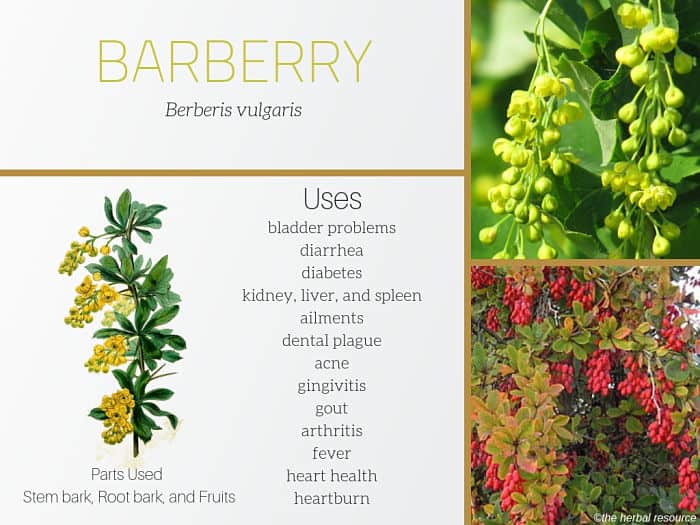
What is Barberry Used For?
Barberry bark and berries have been used for many health conditions throughout the ages. Most of the herb’s uses for health purposes are based on long traditional applications.
In recent years, the plant’s constituents, especially some of its alkaloids, have gained interest within the scientific community and numerous studies have been conducted on their effectiveness.
People have used barberry for, e.g., the following conditions:
- diarrhea
- diabetes
- kidney, liver, and spleen ailments
- dental plague
- acne
- gingivitis
- bladder problems
- constipation
- gout
- arthritis
- fever
- heart health
- blood circulation
- heartburn
Antibiotic Effect of Barberry
Barberry has been shown to be effective in fighting bacterial, viral, fungal and parasitic infections.
The plant bark contains few alkaloids of which berberine is the most prominent, and according to laboratory studies, it has an antimicrobial, anti-inflammatory, hypotensive, sedative, and anticonvulsant effect.
The Immune System
Berberine is possibly an immune system enhancer by stimulating specific immune cells, so they work better.
Diarrhea
Barberry is commonly used to treat bacterial diarrhea and parasitic infections of the intestines.
Research studies indicate that berberine inhibits bacteria’s ability to attach to the cells in the body, which helps prevent infections. 1
Due to berberine’s bactericidal properties, it can be used against a variety of bacterial strains, such as Pseudomonas aeruginosa, Salmonella typhi, Staphylococcus aureus, Viridans streptococci and Escherichia coli.
Yeast infection
Research has shown that herbs that contain berberine may be used as remedies for yeast infections.
Studies show berberine kills Candida albicans by inhibiting the production of critical components in their cell membrane. 2
The herb’s bactericidal and fungicidal effect can make it useful for amoebic dysentery, malaria, cholera, giardia, salmonella, E. coli and similar gastrointestinal infections.
Also, berberine inhibits Heliobacter pylori, a bacterium involved in gastric ulcer and inflammation of the stomach lining of the stomach. 3
May Enhance Heart Function
Studies indicate that berbamine, another alkaloid found in barberry, can protect the heart from ischemia-reperfusion injury, tissue damage caused when blood supply returns to the tissue after a period of lack of oxygen.
Berbamine regulates the concentration of calcium ions inside the cells and halts the activation of calpain (calcium-dependent protease), often involved in some causes of heart failure. 4
Also, the alkaloid strengthens the contraction of the heart muscle by enhancing the cells’ sensitivity to calcium which plays a part in regulating muscle contraction. 5
Berbamine might also be helpful in reducing inflammation and has been found to be helpful in treating amebic hepatitis and rheumatoid arthritis.
And like berberine, berbamine is thought to fight infections, by stimulating the action of white blood cell.
Barberry May be Useful for Diabetes
A few studies in recent years have indicated that barberry could be helpful as protection and treatment for Type 2 diabetes.
One preliminary study showed that when individuals suffering from diabetes 2 were given a combination of barberry and milk thistle for 90 days, the blood sugar levels improved. 6
In another study, taking 500 milligrams of berberine two to three times daily for three months was compared to taking a common diabetes drug (metformin).
The results were that berberine was able to control blood sugar levels and lipid metabolism just as effectively as metformin. 7
Both these studies were indicative and showed promise of barberry as a natural treatment for diabetes, but more and thorough studies are needed to confirm the herb’s effectiveness fully.
Other Uses
.
Barberry has traditionally been used as a treatment for digestive disorders, and due to its anti-inflammatory and antibiotic properties, it has been used in the treatment of urinary tract and bladder infections, upper respiratory infections, and abnormal uterine bleeding.
It has also been used for high blood pressure, heartburn, nausea, high fever and for improving digestion and reducing gastrointestinal pain.
Like the closely related plant Oregon grape, barberry is thought to stimulate blood flow to the liver and improve liver function. It is also believed to stimulate the secretion of bile.
Early research indicates that barberry if used internally in tablet form, might reduce acne in teenagers. 8
External Uses
Oinments containing barberry and metronidazole have been used for vaginal infection (bacterial vaginosis). The oinment seems to stop any recurring infections. 9
Few studies indicate that brushing teeth with a barberry extract gel might reduce dental plaque similarly to commercial toothpaste.
Barberry extract used in a salve may reduce symptoms of psoriasis, but there is currently not enough clinical evidence to support this claim.
Active Substances and Constituents
The root bark contains 1-3% of the alkaloid berberine and minor amounts of other alkaloids (berbamine, oxycontin, palmatine, etc.). The root bark also contains tannins, resins, and chelidonic acid
The fruits contain hardly any alkaloids, but they contain fructose, glucose, gum, pectin, vitamin C and dyes (e.g., carotene, lutein, and zeaxanthin).
Berberine is quite toxic, but in small doses, it stimulates the smooth muscle of the heart, intestinal and urinary tract and may cause uterine contraction.
Berberine has been shown to have bactericidal properties, and other alkaloids present in the plant are thought to have an antipyretic effect.
Other plants containing berberine:
- Goldenseal (Hydrastis canadensis)
- Oregon grape (Berberis aquifolium)
Chinese goldthread (Coptis chinensis) - Indian barberry (Berberis aristata)
- Amur cork tree (Phellodendron amurense)
- Californian poppy (Eschscholzia californica)
- Prickly poppy (Argemone mexicana)
- Yellowroot (Xanthorhiza simplicissima)
Plant Parts Used
When barberry is intended as herbal medicine, it is primarily the stem bark, root bark, and the fresh or dried fruit that are used.
The yellow root bark has the highest concentration of the active therapeutic substances.
The bark of stems and roots are collected in the spring (March) or autumn (November), and dried for later use.
The berries are picked when they are ripe in the fall and are used to make juice, gels, and jams.
Dosage and Administration
Barberry can be used in many different ways and a variety of forms such as a tisane, dried herb, tablet, tincture or capsule.
Barberry capsules should preferably be standardized to contain 5 to 12% isoquinoline alkaloids.
As a tea: Whole or crushed berries that are steeped in 2/3 cups of boiling water for 10-15 minutes is the preferred method of administration. 2 to 4 grams of dried root or 1 to 2 tsp can also be used.
As a tincture: ½ to 1-1/2 tsp. or 250 to 500 milligrams of dry extract three times daily.
As an ointment: 10% barberry extract applied to the skin three times a day.
The dosage and method of delivery will depend on the condition being treated.
Some conditions, like digestive problems, benefit from ingestion of the herb, while other conditions may benefit more from the topical application of a salve.
A doctor or herbalist can give the best advice on dosage.
Potential Side Effects of Barberry
As with other herbs containing berberine, barberry should not be used by pregnant women because it is a uterine stimulant.
Barberry is not recommended for children as there has not been enough research on the plant to warrant any form of dosing information.
No studies have been done on the safety of it in nursing women, and therefore it is probably best to avoid using it while nursing.
When used in appropriate doses, barberry has no reported side effects. In excessive doses, it may cause nosebleed, diarrhea, and vomiting.
It may also cause kidney problems. Pain during urination, blood in the urine and low back pain are symptoms of kidney problems and should be reported to a professional healthcare provider immediately.
This herb may interact with other medications, so those who are under the care of a doctor and taking prescribed medications should not take it until they have discussed it with their doctor.
Other Common Names
- Common barberry
- European barberry
- Berberry
- Sow berry
- Sourberry
- Jaundice-berry
- Pipperidge bush
- Piprage
- Sauerdorn (German)
- Agracejo (Spanish)
- Ryðbroddur (Icelandic)
- Epine-vinette (French)
- Happomarja (Finnish)
- Almindelig berberis (Danish)
Habitat
Barberry is native to Europe and Asia, and it has been introduced to North America where it can be found growing wild from Canada to Pennsylvania.
Because it is such an adaptable plant, its habitat varies hugely as any soil and condition are conducive to its growth. When left to grow wild it can grow as tall as 7 to 10 feet high.
Barberry prefers areas of full sunlight with some partial shade.
Plant Description
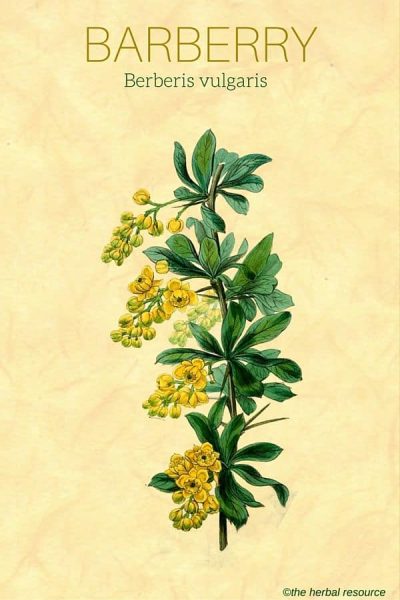
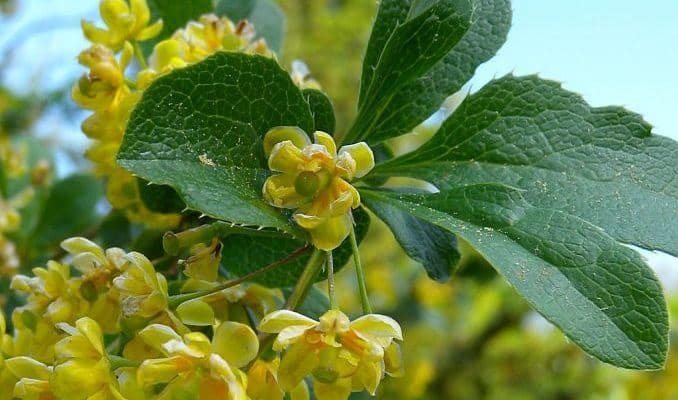
The shrub itself has gray, thorny branches with bright yellow flowers that bloom between April and June. The flowers turn into drooping, dark red berries in the fall.
Supporting References
Atkins, Rosie, et al.: Herbs. The Essential Guide for a Modern World. London, Rodale International Ltd. 2006.
Balch, Phyllis A.: Prescription for Herbal Healing. New York, Avery 2002.
Bown, Deni: The Royal Horticultural Society New Encyclopedia of Herbs & Their Uses. London, Dorling Kindersley 2002.
Hershoff, Asa & Andrea Rotelli: Herbal Remedies. A Quick and Easy Guide to Common Disorders and Their Herbal Treatments. New York, Avery 2001.
Examin.com – Berberine
Hoffmann, David: Medicinal Herbalism. The Science and Practice of Herbal Medicine. Rochester, Healing Art Press 2003.
Howard, Michael: A-Z of Traditional Herbal Remedies. London, Senate 1987.
McIntyre, Anne: The Complete Herbal Tutor. London, Octopus Publishing Group Ltd. 2010.
Murray, Michael and Joseph Pizzorno: Encyclopedia of Natural Medicine. Revised 2.nd edition. London, Little, Brown and Company 1998.
Stuart, Malcolm: The Encyclopedia of Herbs and Herbalism. London, Orbis Publishing 1979.
van Wyk, Ben-Erik & Michael Wink: Medicinal Plants of the World. Portland, Oregon, Timber Press 2004.


Thordur Sturluson
Latest posts by Thordur Sturluson (see all)
- What is the Difference Between Hemp and Marijuana? - June 3, 2019

Leave a Reply