Botanical Name: Taraxacum officinale, Taraxacum mongolicum, Taraxacum palustre, Taraxacum vulgar.
Dandelion was first mentioned for its medicinal qualities in the works of Arabian physicians of the tenth and eleventh centuries.
These writers speak of it as a form of wild endive, under the name of Taraxacon.
The genus name, Taraxacum, is derived from the Greek taraxos, meaning “disorder,” and akos, meaning “remedy”.
Dandelion is believed to be one of the bitter herbs in the Passover tradition.
Medicinal Properties and Actions
The herb’s actions are cholagogues, choleretic, alkalizing, laxative, venotonic, astringent, diuretic, tonic and slightly aperient.
It is a general stimulant, but especially tonic to the urinary system. It is considered by herbalists to be antioxidant and an anti-cancer agent.
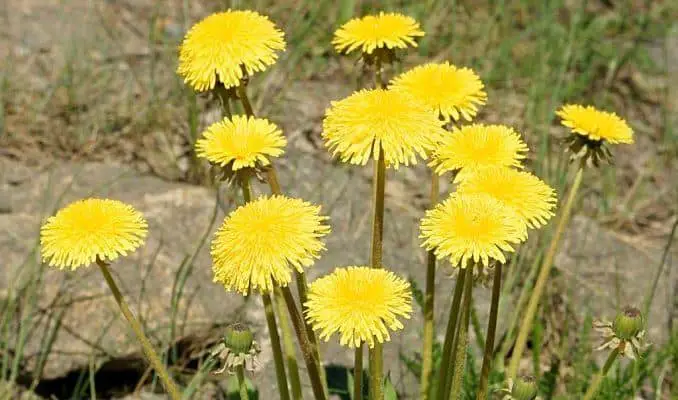
Traditional Uses of Dandelion
The Iroquois, Ojibwe and Rappahannock Native American tribes of North America prepared infusions and decoctions of the root and herb to treat kidney disease, dyspepsia, and heartburn.
In traditional Arabian medicine, dandelion has been used to treat liver and spleen disorders.
In traditional Chinese medicine (TCM), dandelion is combined with other herbs to treat hepatitis, to enhance the immune response to upper respiratory infections, bronchitis or pneumonia, and as a topical compress for mastitis (breast inflammation).
Dandelion is traditionally used as a general tonic, for constipation, for inflammatory skin conditions such as acne, and eczema, and as an herbal remedy for diseases like psoriasis.
Traditional herbalists use dandelion as a treatment for arthritic conditions, including severe conditions such as osteoarthritis, disorders such as gout, and chronic joint pain.
Dandelion has been used for centuries as an herbal treatment for jaundice and the yellowing of the skin that is associated with liver dysfunction, cirrhosis, hepatitis and liver disease.
Modern Day Uses and Applications
The bitter constituents of dandelion, which are sesquiterpene lactones of the eudesmanolide and germacranolide type, are responsible for its effectiveness as a natural remedy for digestive ailments such as irritable bowel syndrome (IBS). Additionally, it has been used traditionally for liver dysfunction. (1)
Substances contained in dandelion stimulate the functions of the stomach, liver, and bile, causing a high diuresis and helping to eliminate toxins and metabolic wastes through the urine. (2)
It has been used as a natural remedy for hypo acid gastritis, dyspepsia, biliary distichiasis and for preventing the formation of renal calculi. Due to the herb’s diuretic effect, it can be helpful in fighting water retention (edema). (3)
Dandelion is used as a natural remedy to help prevent the formation of gallstones, and if gallstones are already present, the herbal remedy prepared from dandelion leaf may still help by dissolving gallstones and aiding in their elimination. (4)
Dandelion leaf is recommended for natural support for healthy blood pressure and poor digestion by stimulating the circulation of the blood.
The beneficial effect is due in part to dandelion’s high concentration of potassium, calcium, phosphorus, iron, and sodium. (5)
The anti-inflammatory properties of dandelion make it a useful natural remedy for inflammation and muscle spasms. (6)
During the spring season, the leaves and root of dandelion begin to produce mannitol, a substance which is used as a treatment for conditions such as hypertension or a weakened heart. (7)
The blossoms of dandelion are rich in vitamin A and B2, as well as a compound known as helenin. Because these same constituents are used for the treatment of poor night vision (night blindness), dandelion may be an effective treatment for reduced vision at night.
Other Uses
The young spring greens are used as a salad ingredient (before they turn bitter later in the summer). It is often cultivated as a salad crop.
The roasted root is used as a coffee substitute and the herb is often used for seasoning and meat tenderizing.
Dandelion may be fermented into beer, and dandelion wine is a favorite of those who like to make their own home-made wine.
Active Substance and Ingredients
The chief constituents of dandelion are taraxacin, acrystalline, and Taraxacerin, an acrid resin, with inulin (a sugar which replaces starch in many of the dandelion family, Compositae), gluten, gum, and potash.
It is rich in vitamins A, C, D, B-complex, iron, magnesium, zinc, potassium, manganese, choline, calcium, and boron.
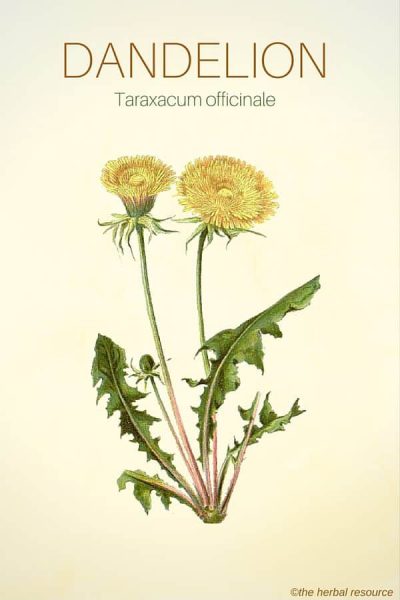
Plant Parts Used
It is the leaves and root of the plant that is used in herbal medicine.
Preparation and Usage
Dried leaf infusion: 1 – 2 teaspoonfuls, 3 times daily. Pour hot water onto dried leaf and steep for 5 – 10 minutes. Drink as directed.
Dried root decoction: 1/2 – 2 teaspoonfuls, 3 times daily. Place root into boiling water for 5 – 10 minutes. Strain and drink as directed.
Leaf tincture (1:5) in 30% alcohol: 100 – 150 drops, 3 times daily.
Standardized powdered extract (4:1) leaf: 500 mg, 1 – 3 times daily.
Root tincture (1:2) fresh root in 45% alcohol: 100 – 150 drops, 3 times daily.
Potential Side Effects of Dandelion
Dandelion is generally considered safe to use. Some individuals may develop an allergic reaction.
People with an allergy to ragweed, chrysanthemums, marigold, chamomile, yarrow, daisies or iodine, may need to avoid dandelion, which is in the same family (Compositae).
Those with liver or gallbladder problems need to consult with a physician before using preparations. If there is any obstruction of the bile ducts, dandelion should not be used.
Dandelion is stimulating to the digestive system, and in some individuals may cause overproduction of stomach acids; therefore, those who are affected by long-term and persistent cases of stomach ulcer or gastritis should take extreme caution before using dandelion.
Dandelion is a diuretic and may increase the excretion of drugs from the body.
People taking prescription medications should always consult a professional healthcare provider before taking supplements, which may interact with conventional medications.
Other Common Names
- Blowball,
- Canker wort
- Clock flower
- Dente de lion,
- Dudhal
- Dumble-dor
- Fairy clock
- Huang hua di ding (yellow flower earth nail)
- Irish daisy
- Lion’s tooth
- Lowenzahnwurzel
- Mælkebotte
- Milk gowan
- Min-deul-rre
- Monk’s head
- Mongoloid dandelion
- Priest’s crown
- Puffball
- Swine snout
- Tell-time
- White endive
- Wild endive
- Witches’ milk.
Habitat
Dandelion can be found in the temperate regions of Europe, Asia, and North America. Hundreds of species of this hardy and beneficial herb are found throughout the Northern Hemisphere.
Some botanists believe that the plant is circumpolar; that is, native to all the temperate regions of the northern hemisphere.
Others botanists classify the dandelion as a species introduced to North America from Eurasia. It is found growing wild in meadows, pastures, waste grounds, sand, gravel, rocks, and even cracks in concrete.
Most commercial dandelion is cultivated in Bulgaria, Hungary, Poland, Romania, and the United Kingdom.
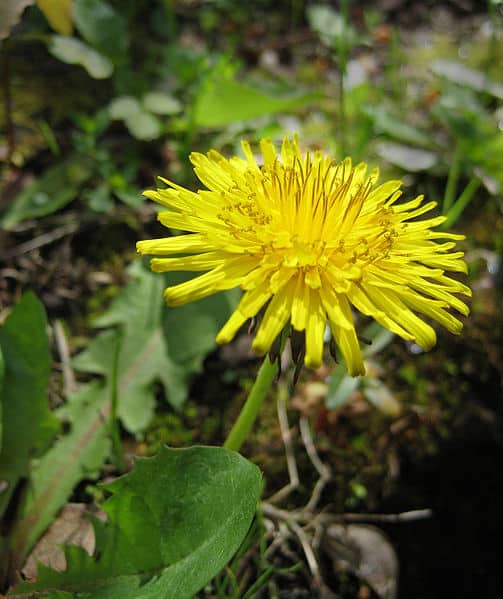
Plant Description
Dandelion is a hardy, variable perennial that is closely related to chicory (Cichorium intybus) that can reach a height of nearly 12 inches.
The roots are fleshy and brittle roots are filled with a white milky substance that is bitter and slightly odorous. The dark brown roots may reach into the soil for a foot or more.
The shiny, hairless leaves are irregularly dentate or pinnate, either oblong or spatulate. The leaves grow in a rosette from the milky taproot. The grooved leaves funnel rainfall down to the roots.
The yellow flowers grow singly on a straight stem that is leafless, hollow, smooth and pale green; it may be tinged with mauve. The flowers are light-sensitive, opening in the morning and closing in the evening or in the event of cloudy weather.
The familiar puff-ball that succeeds the flower is a globular cluster of achenes, each of which is fitted with a parachute-like tuft that easily floats on the breeze in order to distribute the seeds.
Supporting References
Blumenthal, Mark: Herbal Medicine: Expanded Commission E Monographs. Austin, Texas. American Botanical Council 2000 (2005)
Evidence-Based Systematic Review of Dandelion (Taraxacum officinale) by Natural Standard Research Collaboration, Journal of Herbal Pharmacotherapy, 5:1, 79-93.
Wood, Matthew: The Book of Herbal Wisdom: Using Plants as Medicines. Berkeley. North Atlantic Books 1997.
Foster, Steven: Herbs for Your Health: A Handy Guide for Knowing and Using 50 Common Herbs. Loveland, Colorado. Interweave Press 1996.
Williamson, Elisabeth M.: Potter’s Herbal Cyclopaedia. Essex. Saffron Walden 2003.
Hoffmann, David: Healthy Digestion. Dublin, Ireland. Newleaf 2001.
Ottariano, Steven G.: Medicinal Herbal Therapy. Portsmouth. Nicolin Fields Publishing 1999.
Mills, Simon & Kerry Bone: The Essential Guide to Herbal Safety. St. Louis. Elsevier 2005.
Murray, Michael T.: The Healing Power of Herbs: The Enlightened Person’s Guide to the Wonders of Medicinal Plants. 2nd Ed. Rocklin. Prima Health 1995.


Thordur Sturluson
Latest posts by Thordur Sturluson (see all)
- What is the Difference Between Hemp and Marijuana? - June 3, 2019

You’ve missed out two important common names; “Pis-en-lit” (French) and the English counterpart “wet the bed”. These names are due to it’s strong diuretic action.
This is an amazing plant. I would recommend all of those interested in boosting their health, to routinely make good use of dandelion from their gardens. However, don’t use the dandelion if you have sprayed pesticides or such in the area from which you are picking. Meantime, there are other products you can use to spray instead of those deadly “cides”.
In spring and early summer, I use dandelion leaves in my smoothy every morning. I also freeze them for winter, after very shortly blanching them. I have done so all my life and am still here happy and healthy. I am 90 years young.