Botanical Name:: Inula helenium.
Other Common Names: Scabwort, marchalan, elf dock, wild sunflower, horseheal, velvet dock.
Habitat: Elecampane can be found throughout Great Britain, central and southern Europe, the temperate zones of Asia west of the Himalayas, and the eastern and central regions of North America.
It is found growing wild in damp meadows, wet-mesic pastures, old fields, and roadsides. It prefers a moist, well-drained clay loam in a damp, partly shaded environment and is easily grown from seed and from cuttings.
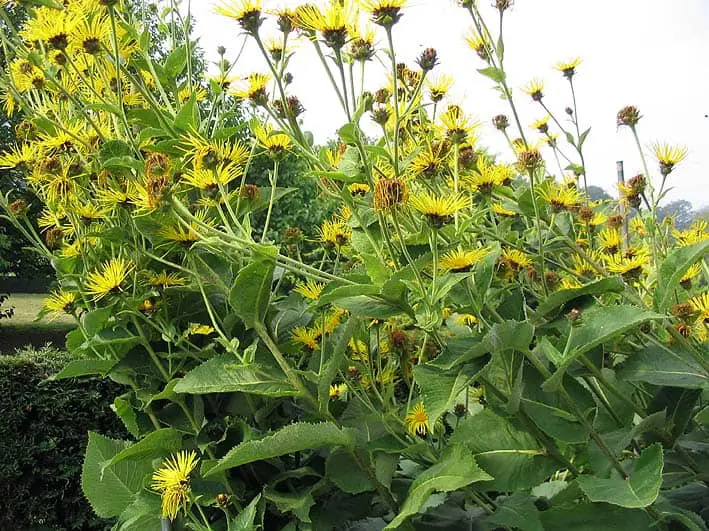
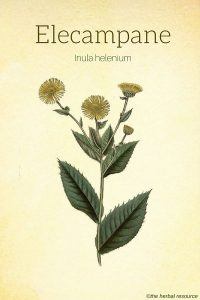
Plant Description: Elecampane is a large beautiful plant with leaves that are similar to the downy leaves of great mullein.
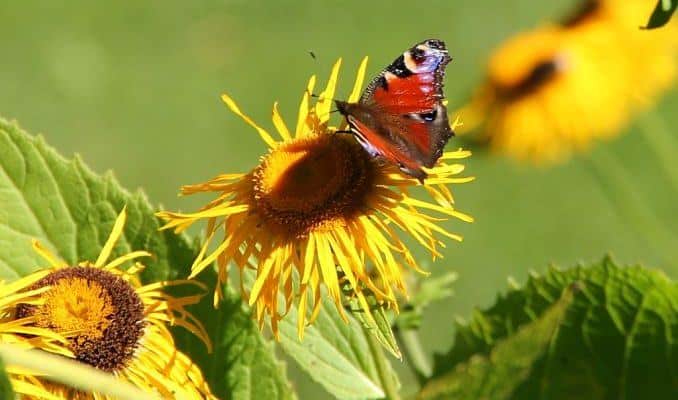
The flowers look like small sunflowers. They are bright yellow, about 4 inches in diameter, and bloom mid to late summer.
The sturdy, deeply furrowed stem rises from a basal rosette of large, ovate, pointed leaves.
Elecampane reaches a height of 3-6 feet; often found growing in hedgerows. The lower stem is hairy, becoming sparsely branched and downy at the top.
The root, the part that is used medicinally, is a thick cylindrical branched rhizome that is yellow on the outside but white inside. It has a warm bitter taste and a scent which is said to resemble violets in bloom.
Plant Part Used: Root or rhizome.
Therapeutic Uses, Benefits and Claims of Elecampane
Elecampane constituents are inulin, mucilage, volatile oil (helenin, camphor, alantol), alantoic acid, a thymol derivative, sesquiterpene lactones (including alantolactone, isoalantolactone), triterpenoid saponins, sterols, and bitter principles (possibly including dammaradienol, stigmasterol, friedlin), resin, pectin, and possible alkaloid.
Its actions are expectorant, antitussive, sedative, anthelmintic, diaphoretic, stomachic, antifungal, antiparasitic, relaxant, warming, tonic, alterative, diuretic and anti-bacterial.
There is a legend that tells how the name inula comes from Helen of Troy, whose tears turned into the healing plant known as elecampane.
Ancient Greeks and Romans considered elecampane as a cure-all for a broad range of ailments; it was considered a useful herbal remedy for dropsy, digestive upsets, menstrual disorders, and sciatica. Elecampane was used as an herbal cold remedy Elecampane (Inula helenium) – Illustration[/caption]In the 19th century, the roots were used to prepare cough drops, asthma lozenges and candy.
Medieval herbalists used the herb as the main ingredient in a digestive wine called “potio Paulina” after St. Paul’s suggestion to use a little wine for the stomach’s sake.
This plant has a long history in veterinary medicine as an effective remedy for skin diseases of sheep and horses. The veterinary use of elecampane is the origin of the herb’s other names, scabwort, and horseheal.
Elecampane was once listed in the U.S. Pharmacopeia and has been long valued as a tonic herb for the respiratory system. It was used traditionally as a specific remedy for chronic bronchitis and bronchial asthma. It was thought to soothe the bronchial tube linings and act as an expectorant.
Inula helenium is believed to be useful in any respiratory condition which produces copious mucus discharge and it is specifically indicated in the irritating cough of bronchitis, especially in children.
Inula helenium was traditionally used to treat the cough of pulmonary tuberculosis. Research has shown that the volatile oil is active against the tubercle bacillus.
The volatile oil stimulates the mucociliary escalator and circulation, while the saponins stimulate the removal of mucus from the lungs.
The constituents alatolactone and other related compounds have expectorant, secretolytic and antitussive actions; these have also demonstrated antibacterial and antifungal qualities.
For the treatment of respiratory problems, elecampane combines well with marribium, tussilago, asclepias and achillea.
It is a traditional remedy for worms; the constituent alantolactone has been used as an anthelmintic in the treatment of roundworm, threadworm, hookworm and whipworm infestation.
Chinese research has demonstrated a mild antibacterial action of the herb as well as a stimulating effect on the nervous system, digestion, and adrenal cortex.
Elecampane is used as a flavoring agent in digestive liqueurs and vermouth, it is used in candy and is often added to cough tinctures and pastilles.
Dosage and Administration
The following dosage is often recommended by herbalists.
Dried root: 1.5 – 3 g or by decoction, 3 times daily.
Liquid extract: 1:1 in 25% alcohol, 1-2 ml, 3 times daily.
Tincture: 1:5 in 25% alcohol, 3-5 ml, 3 times daily. Syrup for coughs: 10-20 ml.
Side Effects and Possible Interactions of Elecampane
Although elecampane is considered a valuable herbal remedy for many conditions, occasional allergic reactions may occur. It should not be used during pregnancy.
A professional healthcare professional should always be informed of any use of other medications, vitamins or medicinal herbs before using the herb as herbal medicine.
It is also vital to find a reputable source to ensure the herbal supplement is of high quality.


Thordur Sturluson
Latest posts by Thordur Sturluson (see all)
- What is the Difference Between Hemp and Marijuana? - June 3, 2019
Hi,
I am so interested in holistic approach for my frenchie.
No more antibiotics or steroids or chemicals.
I have found information from your site regarding elecampane.
My girl is struggling with mucus and breathing. The vet tells me she is overweight and prescribed powder for pigs and horses.
Could you please tell me the dosage of elecampane?
Sadly here in UK a lot of herbs and plants are not recognised for dogs.
I have bought some from Betsy but don’t know how to use it.
Thank you
Yvonne Hope