Botanical Name: Filipendula ulmaria.
The medicinal perennial herb belongs to the plant family Rosaceae. The genus name “Filipendula” has been derived from two words – “filum,” which means “thread” and “pendulus,” which means “hanging.”
This perhaps describes the root tubers, which hang characteristically from the roots. The specific epithet name “ulmaria” denotes “elm-like”; however, this plant does not appear like the elm!
Other Common Names: Bridewort, dollof, ergecsakali, European meadowsweet, lady of the meadow, meadow queen, meadow-wort, meadsweet, moerasspirea, pride of the meadow, queen of the meadow, and ulmaria.
Habitat: Meadowsweet grows commonly in damp meadows, fens, marshes, wet swamps, wet woods, and wet rock ledges; however, it does not grow on acid peats.
The plant is native to Europe and West Asia. Later, the medicinal plant has been introduced and cultivated in North America.
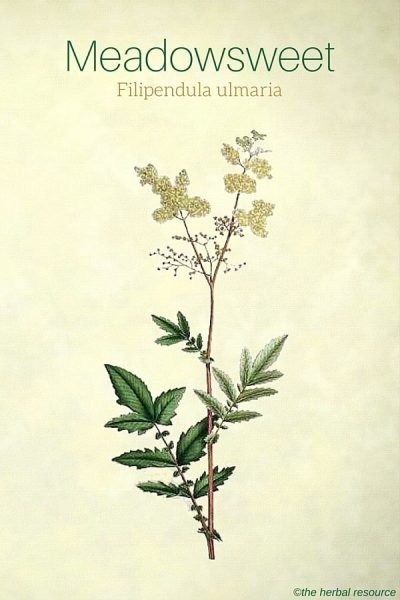
Plant Description: Meadowsweet is a perennial herbaceous plant. The stems are erect, grooved, and reddish to purple in color.
The stems grow up to one to two meters in height. The leaves are pinnately compound with serrate leaflets – usually three to five-lobed.
The leaflets are dark green in color on the adaxial side and whitish on the abaxial side.
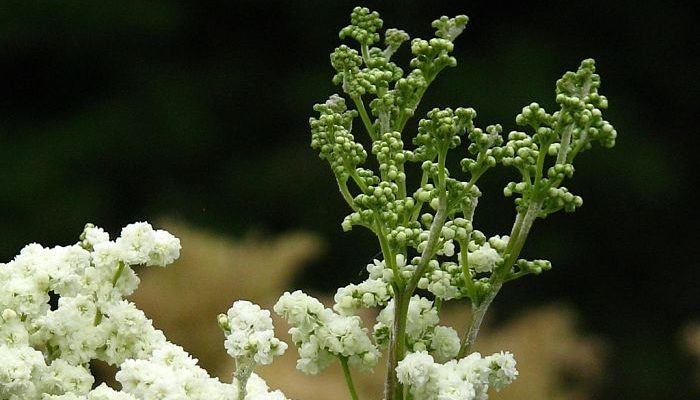
The flowers are arranged on a cymose inflorescence, which is beautiful, delicate, and creamy-white in color. The flowers have a very sweet and strong smell.
Plant Parts Used: Whole plant; however, the commonly used plant parts are fresh leaves, dried leaves, flowers, and roots.
Therapeutic Uses, Benefits and Claims of Meadowsweet
Filipendula ulmaria is believed to have various medicinal properties such as an anti-inflammatory, antiseptic, diaphoretic diuretic, hemostatic, sanative, stomachic, and tonic.
The fresh root is frequently utilized in a small amount in many homeopathic preparations for various ailments. The active ingredients present in this medicinal plant are essential oils, flavonoids, phenolic glycosides, salicylic acid, and tannins.
Meadowsweet was one of the three holiest medicinal herbs of the Druids. The flowering twigs and leaves are used in various medicinal preparations.
The plant parts can be dried and stored for future use. The inflorescence consists of salicylic acid, which is used in the synthesis of the drug aspirin.
The medicinal plant is a valuable herbal remedy for diarrhea, and it is believed to be very effective in the treatment of diarrhea in children. (1)
Meadowsweet seems to be an effective stomachic, which is used in the treatment of gastritis, heartburn, hyperacidity, and peptic ulcers; for such ailments, this medicinal herb is one of the most powerful traditionally used herbal remedies.
In addition, this medicinal plant is a frequently used natural treatment for afflictions of the blood. It is also believed to be very effective against the pathogens that cause diphtheria, both amebic and bacillary dysenteries, and pneumonia. (2)
The entire plant is a natural treatment for an acidic stomach.
This herb has been used for natural pain treatment and to reduce fever. A small amount of the meadowsweet root can be used to get rid of headaches; this is believed to be effective because of the aspirin-like components present in the herb.
A tisane prepared from the meadowsweet flowers can render comfort to individuals affected by the flu.
A strong decoction prepared from the boiled root is used externally to get rid of sores and various ulcers.
Dosage and Administration
It is advised to take one cup of meadowsweet infusion two to three times a day. In the form of tincture, two to four drops of meadowsweet tincture can be applied two to three times a day.
Side Effects and Possible Interactions of Meadowsweet
In some in individuals, meadowsweet may induce tightening of the air ducts present in the lungs; the tightening is known as bronchospasm, which may worsen the asthmatic condition.
People that are allergic to aspirin-like medicines and asthmatic patients should not take meadowsweet medical preparations. At high doses, it may induce gastric ulceration in some cases. (3)
Supporting References
Kovaleva, Tatyana & Alekseevna Ermakova, Valentina & Aleksandrovna Trashchenkova, Daria & Anatolievna Dorovskih, Ekaterina & Bokov, Dmitry & Shilova, I & Aleksandrovna Samylina, Irina. (2018). Comparative Study of the Biologically Active Substances Composition and Content in Meadowsweet (Filipendula ulmaria (L.) Maxim) Crude Herbal Drugs (Herb, Leafs, Flowers) of Russian Origin. 9. 277-280.
Meadowsweet and dropwort showed antioxidant, anti-inflammatory, and gastroprotective activities in vitro and in vivo. From: Samardžić, S., Arsenijević, J., Božić, D., Milenković, M., Tešević, V., & Maksimović, Z. (2018). Antioxidant, anti-inflammatory and gastroprotective activity of Filipendula ulmaria (L.) Maxim. and Filipendula vulgaris Moench. Journal of Ethnopharmacology, 213, 132-137.
Anti-inflammatory action of meadowsweet extracts was demonstrated in vitro and in vivo. From: Katanić, J., Boroja, T., Mihailović, V., Nikles, S., Pan, S. P., Rosić, G., … & Bauer, R. (2016). In vitro and in vivo assessment of meadowsweet (Filipendula ulmaria) as anti-inflammatory agent. Journal of ethnopharmacology, 193, 627-636.


Thordur Sturluson
Latest posts by Thordur Sturluson (see all)
- What is the Difference Between Hemp and Marijuana? - June 3, 2019

Leave a Reply