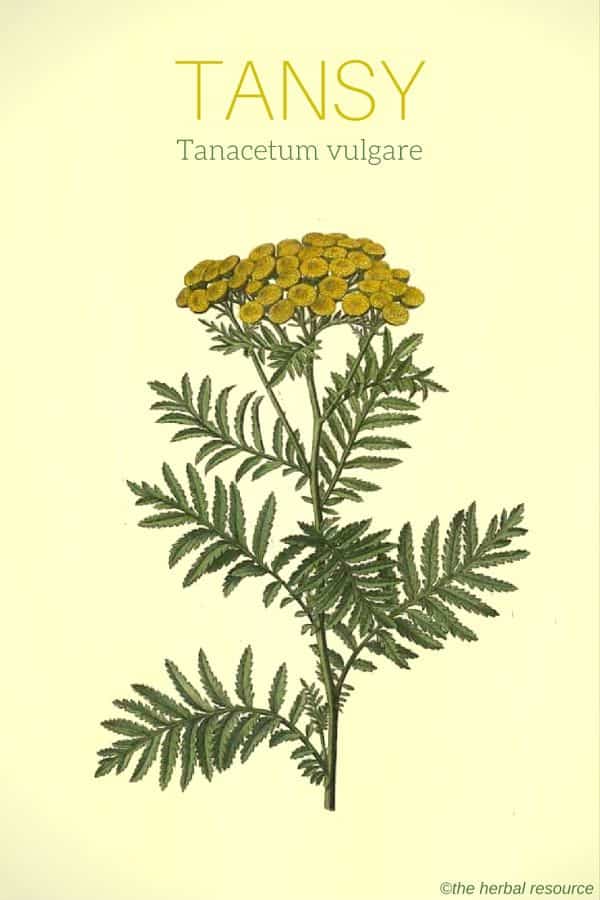
Botanical Name: Tanacetum vulgare.
Other Common Names: Buttons, wild tansy, gold leaf tansy, ginger plant, bitter buttons, hineheel, scented fern, stinking willie.
The common name, tansy, is likely derived from Greek words meaning “immortal”, which may refer to the long-lasting flowers or its traditional use in preserving dead bodies.
Habitat: Although the plant is native to temperate regions of Europe and Asia, it has been introduced throughout the world and grows wild in North America.
This hardy, sun-loving plant is resistant to cold and frost and commonly grows in open areas close to water, such as roadsides and ditches.
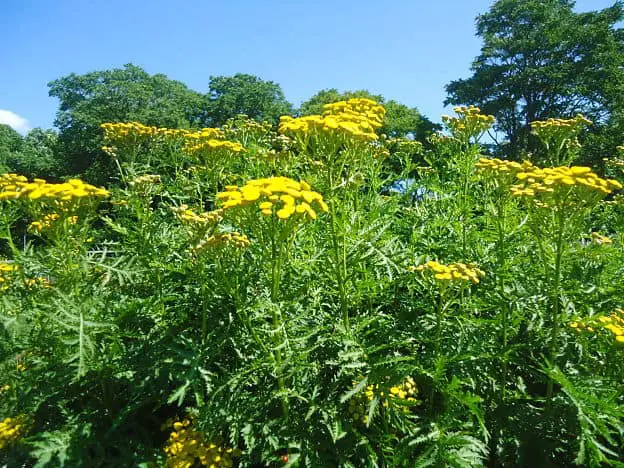
Description: Tanacetum vulgare is a member of the aster family, producing flat, bright yellow, button-like flowers in late summer.
The plant’s alternating leaves are divided into paired serrated segments, giving them a fernlike appearance. Plants reach a height of up to 3 feet.
Tansy can spread quickly as it is a self-sowing perennial that is easily propagated by dividing the plant. The flowers are strongly scented with an aroma that has been compared with camphor.
This plant can be highly toxic and is rarely used by modern herbalists.
Plant Parts Used: Leaves, used fresh or dried, and flowers.
Common Tansy (Tanacetum vulgare) is related but chemically different from Tanacetum annum which produces a blue oil commonly called “Blue Tansy”. The oil from Tanacetum vulare is never blue.
Therapeutic Uses, Benefits and Claims of Tansy
Historical records also indicate that tansy has been used as a natural face wash to lighten the skin.
Historically, the most common medicinal use of tansy was as an abortifacient. It naturally stimulates blood flow to the pelvis and uterus (emmenagogue) and was used to bring on menstruation or abort an unwanted pregnancy.
Tanacetum vulgare is an herbal remedy for treating worms as it contains a volatile oil with the active ingredients thujone, camphor and myrtenol, which are toxic to internal parasites.
In the past, the herb was frequently used to treat worms in children and it was also added to coffins to slow the deterioration of the deceased by repelling worms.
Today, it is most commonly used as a natural insect repellent and companion plant in vegetable gardens. However, the herb’s repellent nature has long been recognized.
Tansy has been used externally as an herbal remedy for lice, fleas and scabies. In the Middle Ages, it was strewn across floors, hung from rafters and slipped under bed sheets to discourage pests.
It contains the compound parthenolide, which is also found in feverfew and is thought to help in the prevention of migraines.
When applied as a poultice, the herb is a natural treatment for skin infections and can be used to relieve sprains and reduce swelling.
Other medicinal uses of tansy include the treatment of colic, gout and plague.
Dosage and Administration
Tansy contains a volatile oil with the active ingredient thujone, which can be toxic in the wrong dosage.
The percentage of thujone in the oil is unpredictable as it varies greatly between plants.
This variability seems to be related to genetic rather than environmental factors, which makes it very challenging to determine dosage. Each plant would need to be tested for thujone concentrations.
A tea infusion can be prepared by pouring one cup of boiling water over 1 teaspoonful of the dried tansy. Leave to infuse for 10 – 15 minutes and drink twice daily. The tea is strong and bitter in taste.
The herb may also be found as a tincture; 1-2 ml taken three times daily.
The fresh green leaves can be pounded and applied as a poultice.

Side Effects and Possible Interactions of Tansy
Tansy should only be used in the hands of an expert as an incorrect dosage can be highly toxic, causing hallucinations, spasms, convulsions, and even death. In most cases, alternative herbal remedies exist.
Due to its emmenagogue properties, it should not be taken while pregnant as it can lead to miscarriage.


Thordur Sturluson
Latest posts by Thordur Sturluson (see all)
- What is the Difference Between Hemp and Marijuana? - June 3, 2019

Hello… I have been taking black walnut as well as pathoguard product s for intestinal parasites and worms…is it Ok to stop everything for a week or so and take Tansy 900 mg daily to see if this works better for me… I have been on the others since may.. Lynn. Thank you for your time and help
When talking about the uses above, were you using the leaves – flowers – or both?
From the article:
“Plant Parts Used: Leaves, used fresh or dried, and flowers”
Is tansy and blue tansy is same plant?
Ruby, good question. Common Tansy and Blue Tansy are in the same genus but are different species. To help clarify, we have just added this passage:
“Common Tansy (Tanacetum vulgare) is related but chemically different from Tanacetum annum which produces a blue oil commonly called “Blue Tansy”. The oil from Tanacetum vulare is never blue.”