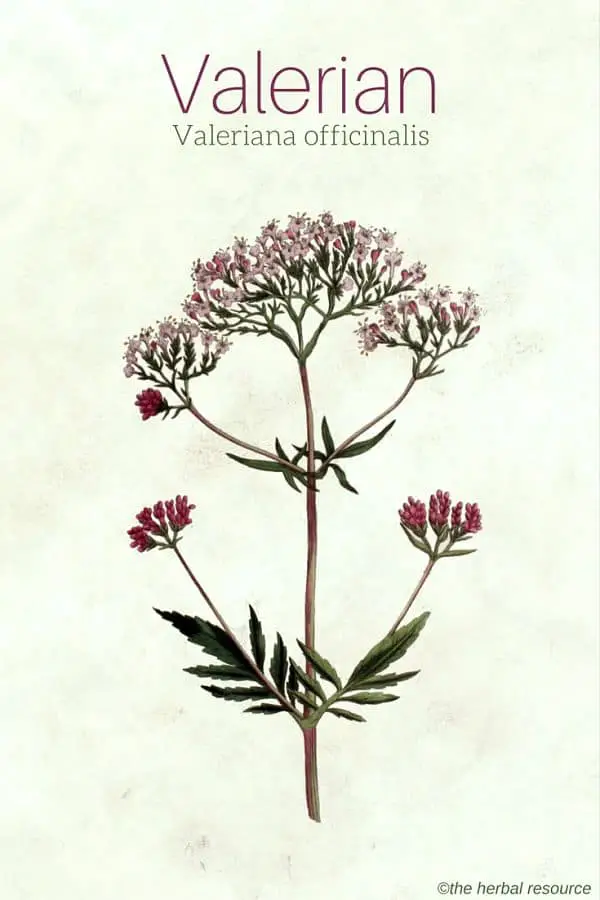
Botanical Name: Valeriana officinalis.
Other Common Names: Valerian root, garden valerian, tobacco root, garden heliotrope, all-heal, phu (Galen), great wild valerian, amantilla, setwall, setewale capon’s tail.
Habitat: The plant is native to Europe, South Africa and parts of Asia. It has naturalized in North America. It prefers rich, heavy loam with adequate moisture.
Most of the valerian used in medicine is grown on farms and cultivated for this purpose.
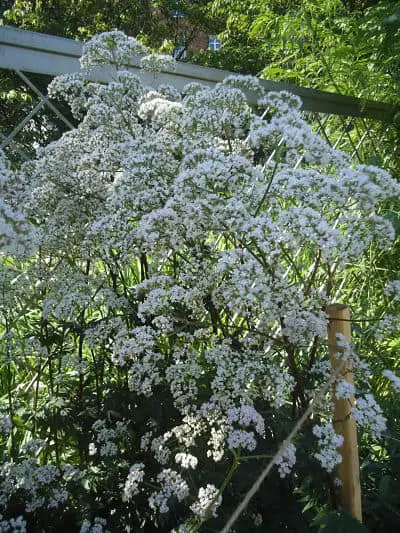
Description: The valerian plant is a perennial that can reach a height of 4 feet.
The stems of the plant are erect and hollow with white or reddish flowers that bloom each summer. The leaves are dark green and paired at their base.
The flowers have a peculiar, though not completely unpleasing, scent. Some describe the scent as similar to well-aged cheese or milk.
Plant Parts Used: The root and rhizome are used for medicinal purposes.
Therapeutic Uses, Benefits and Claims of Valerian Root
Active Ingredients and Substances: The root of valerian contains iridoids called valepotriates, glucoside (valerosidatum), about 1.4 percent essential oil and alkaloids.
It is the isovaleric acid that during drying and storage decomposes and produces the characteristic smell of the herb.
Furthermore, the root contains flavonoids, mucous substances, tannins, resins, sugars, starches, fats, manganese, calcium, choline, and B vitamins. The most active ingredients are found in the fresh root.
The valepotriates are very unstable compounds, and there is almost nothing left of them in tinctures and extracts of valerian.
It is still unclear whether the medicinal effects of the herb are caused by a single chemical substance or group of them working together.
There are around 200 species in the genus Valeriana and the active ingredients can vary from species to species. The health properties of the plant also seem to depend on factors such as the age of the plant, the age of the extract and habitat.
Valerian Uses as an Herbal Sleep Aid
Valerian root is mainly used as an herbal sleep aid.
The plant has been shown to provide both improved sleep quality and longer sleep, without giving the “hangover” feeling in the morning like so many synthetic medications used to treat insomnia.
In the 1980s, Swiss researchers studied the effects of valerian root on sleep patterns and found that the herb reduced the time it took to fall asleep, especially in elderly patients and those with sleep disorders.
Some clinical trials have suggested it should be used for two to four weeks before the daily mood and sleep patterns are improved. The herb is, therefore, perhaps not particularly well-suited for acute insomnia.
It is also worth noting that valerian can act as a diuretic so that preparations of the herb might not work well as a sleeping aid for people who have a tendency to get up and urinate at night.
Valerian root is, however, one of the mildest and most harmless herbal sleep aids there is.
Other Uses
Additionally, the herb has been used for irritability, depression, anxiety, nervousness, exhaustion, delusions, hysteria and nervous tension.
It has also been used as a medicinal herb for panic attacks.
Valerian root has also been shown to relieve pain. This, combined with the sedative effect, makes it effective in relieving headaches (especially stress headaches,) migraines, arthritis and muscle pain.
This herb has also shown promise in treating several nerve disorders. Shingles, sciatica, neuralgia, multiple sclerosis, epilepsy, and peripheral neuropathy are all conditions that respond to valerian use.
Valerian root has also been used as an herbal remedy for ADHD in adults and children along with other childhood nervous disorders.
This plant has a positive effect on heart health. It helps to slow the heart in tachycardia, helps regulate arrhythmias and stabilizes blood pressure. Its anti-thrombotic effect helps to prevent blood clots as well.
Valerian has been used for chronic digestive disorders, stomach cramps, colic, diarrhea and bloating (especially when it is caused by emotional or physical stress or coffee, alcohol, and nicotine abuse).
An Italian scientific study indicates that it could be used to reduce the spasms of the intestinal muscles caused by Crohn’s disease and ulcerative colitis.
Valerian in Combination with Other Herbs
It is possible to increase the effects of valerian by combining it with other herbs. As an herbal sleep aid it can be used with hops (Humulus lupulus) and lemon balm (Melissa officinalis).
Other calming herbs that can be used with it are common skullcap (Scutellaria galericulata), blue skullcap (Scutellaria lateriflora) and passionflower (Passiflora incarnata).
If insomnia and anxiety are associated with depression, the plant can be combined with St. John’s wort (Hypericum perforatum).
If nervous palpitations and high blood pressure related to stress cause insomnia, then valerian and hawthorn (Crataegus monogyna) are a good combination.
For menstrual cramps and spasms in the digestive system the herb can be used with chamomile (Chamomilla recutita) and lavender (Lavandula angustifolia), and for muscle spasms it can be used with cramp bark (Viburnum opulus).
Dosage and Adminstration
The common dosage for valerian root in capsule form for insomnia relief is 300 to 600 mg of the extract. This is equal to about 2 to 3 grams of the dried root infused in a tea.
It is recommended that the herb is taken 30 minutes to two hours before bedtime.
For other uses, the herb may be taken in divided doses throughout the day or in a single dose in the evening.
Possible Side Effects and Interactions of Valerian Root
Valerian root has been given a class 1 safety rating by the American Herbal Products Association (AHPA).
Some people do have adverse effects from the use of this herb, experiencing nervousness, anxiety, and tension instead of relaxation and sedation. There’s evidence that long-term use may lead to withdrawal symptoms upon cessation.
Due to its tranquilizing effect, this herb should not be used while driving, operating heavy machinery or during other activities that require alertness and mental acuity.
People with liver disease should not use this herb.
Pregnant or breastfeeding women should not use this supplement either.
Valerian root should not be taken with medications for anti-anxiety, anesthesia or sedatives without consulting a physician. It should not be mixed with alcohol or recreational drugs that cause sedation.
Supporting References
Robbins, Christopher: The Household Herbal. London, England. Bantam Books 1995.
Chevallier, Andrew: Phytoterapy. Fifty Vital Herbs. London, England. Amberwood Publishing Ltd. 1998.
Corrigan, Desmond: Herbal Medicine for Sleep and Relaxation. Surrey, England. Amberwood Publishing Ltd. 1996.
Mills, Simon & Kerry Bone: The Essential Guide to Herbal Safety. St. Louis. Elsevier 2005.
Kuhn, Merrily A. & David Winston: Winston & Kuhn’s Herbal Therapy & Supplements. A Scientific & Traditional Approach. 2nd Ed. Wolters Kluwe / Lippincott Williams & Wilkins 2008.
Hershoff, Asa & Andrea Rotelli: Herbal Remedies. A Quick and Easy Guide to Common Disorders and Their Herbal Treatments. New York. Avery 2001.
Duke, James A.: The Green Pharmacy. Emmaus, Pennsylvania. Rodale Press 1997.
Foster, Steven: 101 medicinal herbs. Loveland, Colorado. Interweave Press 1998.


Thordur Sturluson
Latest posts by Thordur Sturluson (see all)
- What is the Difference Between Hemp and Marijuana? - June 3, 2019

does valerian root affect the kidneys