Botanical Name of Cat’s Claw: Uncaria tomentosa.
Other Common Names: Cat’s Claw; Uña de Gato; Paraguayo; Garabato; Garbato Casha; Samento; Tambor Huasca; Uña Huasca; Uña de Gailan; Hawk; Healing Vine of Peru; Uña de Gato; Saventar; Peru Ìuña de Gato Rojaî; Loreto Îgarabato Coloradoî; Ucayali Îuña de Gato de Alturaî; Îgarabato Amarilloî; îbejuco de Aguaî; San Martîn Îgarabatoî.
Habitat: Cat’s claw (Uncaria tomentosa) is native to the rainforest regions of Central and South America, especially in the upper Amazon region of Peru and neighboring countries, including Colombia, Ecuador, Guyana, Trinidad, Venezuela, Suriname, Costa Rica, Guatemala, and Panama.
The plants’ reported range is from Belize in the north to Paraguay in the south. Maranhao, Brazil is the most eastern area where Uncaria tomentosa has been found growing wild.
It favors mountain slopes in the organic soils of the primary (old growth) rainforest, between 250 and 900 meters above sea level. It can also be found in a disturbed forest but rarely in secondary forest. Over-harvesting and destruction of old growth rainforest is a serious threat to Uncaria tomentosa.
Because it is becoming harder to find in the mountain slopes, wild harvesters are substituting its close relative, Uncaria guianensis, a species that grows in the lower elevations closer to the rivers, thus easier to find, collect and transport in the lower areas closer to the rivers.
Plant Description: Uncaria tomentosa (cat’s claw) is a woody vine that may reach over 30 m in height into the rainforest canopy.
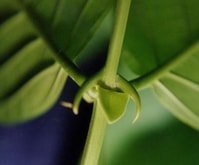
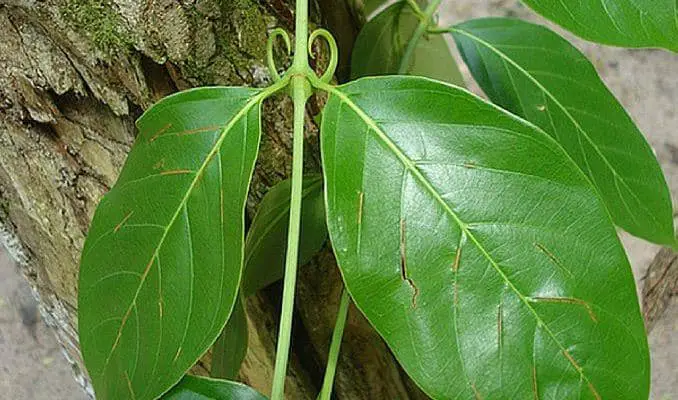
The vine has hook-like thorns that resemble the claws of a cat, giving the plant its name and allowing the vine to attach to tree bark. The vine may reach several centimeters in diameter and often develops roots from the nodes. Its sap is clear and watery with an astringent taste.
The external bark has superficial longitudinal fissures, and the internal bark is fibrous, appearing golden-yellow when ground into a powder. The terminal branchlets are quadrangular and yellow-green in color.
The leaves are bright green, simple, opposite, compound, and dimorphic, with small wide leaflets that are ovate or lanceolate when mature. The curved, hook-like thorns grow at the base of the leaves. The yellow flowers are trumpet-shaped, either solitary or in axillary clusters, 3 inches long and 4 inches across.
The fruit capsules are generally 20 inches long, linear and flat, containing oblong, winged seeds that are wind-dispersed. Tubers are produced by both young and mature plants, allowing for re-growth. If the tubers are left intact when the plant is harvested, the same plant may be harvested again after four years.
Plant Part Used: Bark, root, leaves.
Therapeutic Uses, Benefits, and Claims of Cat’s Claw
Cat’s claw is thought to have the following health properties; antibacterial, anti-inflammatory, antimutagenic, antioxidant, antitumor, antiviral, cytostatic, depurative, diuretic, hypotensive, immunostimulant, vermifuge.
It has been used as an herbal medicine for generations by several native tribes in South America. It has been used traditionally to treat intestinal complaints, asthma, wounds, cancer, tumors, arthritis, inflammations, diabetes, irregularities of the menstrual cycle, fevers, ulcers, dysentery and rheumatism. Reportedly, cat’s claw has been used traditionally as birth control by several different Peruvian indigenous tribes.
The Ash·ninka tribe in central Peru has the longest recorded history of use of cat’s claw as a medicinal plant. The Ash·ninka worshiped this plant, naming it kug-kukjaui. Uncaria tomentosa was the highest deity, giving rise to all other deities. The Ash·ninka carved the images of the minor deities into the long ligneous shoots of the plant, giving their images very long profiles and oval faces.
Contemporary herbalists consider the herb to be a natural immunostimulant, enhancing the function of white blood cells. A group of oxindole alkaloids found in cat’s claw has been documented with immune-boosting and antileukemic properties.
The most immune-boosting constituent is believed to be Isopteropodin (Isomer A), which increases the immune response in the body and acts as an antioxidant to rid the body of free radicals.
Cat’s claw may also work to kill viruses, bacteria, and microorganisms that can cause diseases such as herpes and candida. AIDS patients and those who are HIV positive have been treated with Krallendon, an immune-boosting ingredient of cat’s claw.
Cat’s claw possesses anti-inflammatory properties, primarily due to the glycosides present in the herb, which make it an effective natural remedy for the treatment of arthritis, gastritis, ulcers, and inflammatory bowel disorders.
The glycosides work synergistically to reduce the edema associated with inflammatory conditions. The primary mechanisms for the anti-inflammatory effect of cat’s claw appear to be due to suppression of the TNF-alfa synthesis.
Additional uses as a medicinal herb include treatments for Crohn’s disease, gastric ulcers, colitis, gastritis, diverticulitis, and leaky bowel syndrome and it has a reputation as a good herbal remedy for chronic fatigue syndrome.
The alkaloids rhynchophylline, hirsutine, and mitraphylline that are found in cat’s claw have antihypertensive and vasodilating properties that may be beneficial in preventing strokes and heart attacks by preventing clots in blood vessels, reducing heart rate, lowering blood pressure, increasing circulation, and lowering blood cholesterol levels.
Cat’s claw has been used as a disjunctive treatment for cancer, AIDS and other diseases that affect the immune system.
Early trials with cancer patients taking cat’s claw in conjunction with chemotherapy and radiation therapy reported fewer side effects, such as hair loss, weight loss, nausea, secondary infections, and skin problems. But further studies are needed to confirm this.
Further research substantiates the effectiveness of cat’s claw as an herbal medicine for the treatment of cancer, indicating that cat’s claw could aid in DNA cellular repair and prevent cells from mutating.
It is also thought to help prevent the loss of white blood cells and immune cell damage caused by many chemotherapy drugs (a common side effect called leukopenia.
One research project recently found that the immune-boosting alkaloids pteropodine and isopteropodine in cat’s claw may have a positive modulating effect on brain neurotransmitters called 5-HT(2) receptors. These receptor sites are targets for drugs used in treating conditions such as depression, anxiety, eating disorders, chronic pain conditions and obesity.
Dosage and Administration
Tea: 1 – 10 g (1,000 mg) root bark in 8 ounces water; boil 10 – 15 minutes, cool, and strain. Drink 1 cup 3 times daily or follow the manufacturer’s instructions.
Tincture (solution made from herb and alcohol, or herb, alcohol, and water): 1/4 – 1/2 teaspoonful 2 – 3 times daily or follow the manufacturer’s instructions.
Dry, encapsulated standardized extract: 100 mg per day for osteoarthritis; 250 – 350 mg per day for immune support or follow the manufacturer’s instructions.
Side Effects and Possible Interactions of Cat’s Claw
Cat’s claw appears to have few side effects but presently very little scientific research has been done on the benefits and possible side effects of this herb.
There have been reports of dizziness, nausea, and diarrhea when taking cat’s claw and as it has been used traditionally for birth control it should not be used when pregnant as it may cause miscarriage.
Because cat’s claw may stimulate the immune system, it should not be used with medications intended to suppress the immune system, such as cyclosporin or other medications prescribed following an organ transplant or to treat an autoimmune disease.
Cat’s claw may interact with anticoagulants (blood-thinning medications), diuretics, estrogens or progestins, including birth control pills, and antihypertensive (blood pressure) medications.
The use of herbs is a time-honored way to strengthen the body and treat disease. However, herbs may have side effects and can interact with other herbs, supplements or medications. Always consult with your primary healthcare provider before using cat’s claw.


Thordur Sturluson
Latest posts by Thordur Sturluson (see all)
- What is the Difference Between Hemp and Marijuana? - June 3, 2019

Leave a Reply