Medicinal herbs for bladder infection are among some of the oldest remedies recorded and have a long and successful history in treating UTIs.
Bladder Infections, or what is also known as urinary tract infections (UTI) are prevalent in women but less so in men. Burning, itching and constant urge to urinate are the main symptoms which usually are easy to treat.
Medicinal herbs for urinary tract infections are numerous and depending on the associated symptoms may be combined to suit each condition.
Toilet hygiene also plays an important role in preventing further infections and care should be taken to avoid fecal matter being accidentally wiped forward and infecting the urinary tract.
In acute cystitis, herbs may need to be used in conjunction with a urinary tract alkalizing agent, such as Ural.
Herbal remedies for urinary tract infections (UTI) can also be assisted in their action by increasing water intake to at least two liters per day.
Herbal remedies for bladder infections are cost-effective and easily used, however, if the symptoms are not getting better it is important to seek further diagnosis from a professional healthcare practitioner.
Recurrent bladder and urinary tract infections should be appropriately investigated as many urinary tract illnesses have very similar symptoms.
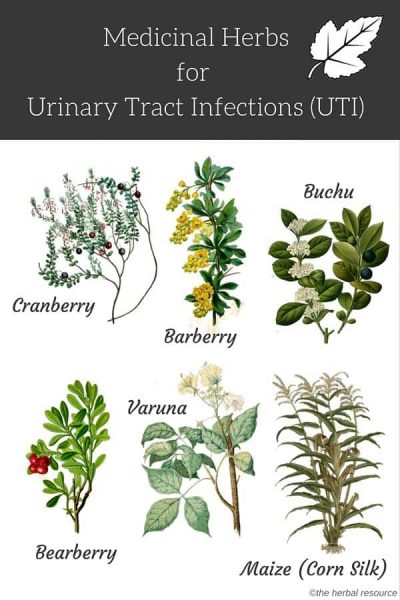
Medicinal Herbs for Urinary Tract Infections
Cranberry
Cranberry (Vaccinium macrocarpon) is one of the most popular and widely used herbal remedies for UTI. This herb is used in the prevention and treatment of urinary tract infections and cystitis.
It is also useful in reducing urinary tract mucus production in patients who have had urinary surgery and patients who are immobilized or catheterized.
The dose of cranberry used in clinical trials was 75 mL per day of cranberry juice or 400 to 800 mg per day of 25:1 dry concentrate) which is the same as 10-20gr of fresh berries per day.
Cranberry should be avoided in patients with renal failure and in those who tend to develop uric acid or calcium oxalate stones (due to the high oxalate content of cranberry).
Buchu
Buchu (Agathosma betulina) is another popular remedy for urinary tract infections.
The leaf of this herb is widely used in western herbal medicine, and its primary use is in the treatment of chronic diseases of the genitourinary tract.
These diseases include chronic inflammation of the mucous membranes of the bladder and urethra, conditions where there are urinary discharges and unusually acidic urine, and incontinence linked to prostate diseases.
Buchu leaf is a diuretic and urinary tract antiseptic, and the latter activity is considered to be due to its essential oil content. The underside of the Buchu leaves has oil glands containing an essential oil which consists mainly of the monoterpene, diosphenol.
It is imperative to make certain that the correct species has been used as the essential oil of other herbs such as ovate buchu (Agathosma crenulata) have lower diosphenol content and higher pulegone content. Pulegone is a potentially toxic constituent.
Buchu can be taken as a tea, with the dose being 5gr steeped in hot water up to four times daily.
Bearberry
Bearberry/uva ursi (Arctostaphylos uva ursi) is often found in combination with buchu as a tea that can be taken to relieve the symptoms of urinary tract infections (UTI).
A dose of 5 grams in hot water can be drunk up to four times daily to treat inflammation and infection.
This tea was customarily used for its astringent action and is of great value in diseases of the bladder and kidneys; where it soothes inflammation of the urinary tract.
Eclectic physicians used Uva ursi to treat chronic irritation of the bladder, bedwetting, mucous and bloody discharges in the urine, chronic diarrhea and dysentery.
Bearberry contains hydroquinone glycosides, including arbutin and methyl-arbutin.
Corn Silk
Like buchu and uva ursi, corn silk (Zea mays) is another herb that can be taken as a tea to soothe and treat the symptoms of UTIs.
This pale yellow tea is also safe for children to use and has a mild diuretic effect.
Corn silk is best used in combination with other stronger antiseptic herbs to treat bladder infections, but it will provide adequate symptom relief from burning and pain associated with a urinary tract infection.
Crataeva
Also known as varuna (Crataeva nurvala), this Indian tree grows along river banks in many parts of India. The bark is mostly used and contains saponins, flavonoids, and plant sterols.
Its use in the natural treatment of urinary tract infections is recorded as far back as the 8th century and in later times has been used to treat kidney stones.
Crataeva is an essential herb in the treatment of chronic or recurrent bladder infections and should be used in combination with urinary tract antiseptics.
The tonic effect on the bladder will decrease the residual volume of urine and assist in the effective removal of micro-organisms from the bladder. In turn, this reduces the risk of chronic infection or re-infection.
Crataeva is also beneficial in the treatment of hypotonic or atonic bladder and works well in benign prostatic hyperplasia in combination with pygeum.
Horseradish
Horseradish (Armoracia rusticana) is perennial plant belongs to the cabbage family (Brassicaceae). A family that also induces also includes mustard, broccoli, and cabbage. It is a root vegetable used as a spice.
The root of the plant contains allyl isothiocyanate (AITC), a substance with a strong antimicrobial effect.
While cranberries have bacteriostatic properties (inhibit the reproduction of bacteria), allyl isothiocyanate (AITC) is bactericidal (kills bacteria). The substance work by attacking the cellular membrane of the bacterium.

High Strength Pure D-Mannose with Cranberry Extract for Natural Urinary Tract Infections and UTI Support/font>
from Vitalite Now
The Herbal Resource may receive a small commission from sales of specific product (but at the same price to you).
Other Herbs Used for Urinary Tract Infections
- Barberry – (Berberis vulgaris)
- Saw Palmetto – (Serenoa repens)
- Yarrow – ( Achillea millefolium)
- Agrimony – (Agrimonia eupatoria)
- Borage – (Borago officinalis)
- Amur Cork Tree – (Phellodendron amurense)
- Pipsissewa – (Chimaphila umbellata)
- Nasturtium – (Tropaeolum majus)
- Boldo – (Peumus boldus)
- Rupturewort – (Herniaria glabra)
- Southernwood – (Artemisia abrotanum)
- Angelica – (Angelica archangelica)
- Cloves – (Syzygium aromaticum)
- Shepherd’s Purse – (Capsella bursa-pastoris)
- White Dead Nettle – (Lamium album)
- Cornflower – (Centaurea cyanus)


Thordur Sturluson
Latest posts by Thordur Sturluson (see all)
- What is the Difference Between Hemp and Marijuana? - June 3, 2019

shepherds purse?